YutyrannusYutyrannus
Yutyrannus huali
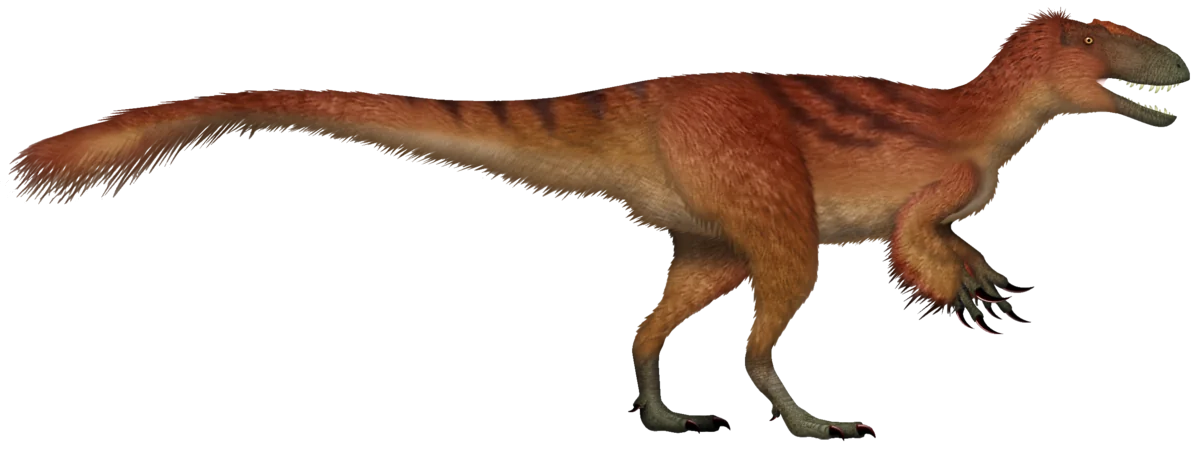
Yutyrannus war ein früher Verwandter von Tyrannosaurus aus der frühen Kreidezeit Chinas. Er wurde etwa 7.5 bis 10 Meter lang und ist der grösste Dinosaurier, bei dem Federn direkt im Fossil erhalten sind. Sein Name bedeutet «gefiederter Tyrann». Er zeigt, dass auch grosse Raubdinosaurier ein Federkleid haben konnten.Yutyrannus was an early relative of Tyrannosaurus from the Early Cretaceous of China. It grew about 7.5 to 10 metres long and is the largest dinosaur with feathers directly preserved in the fossil. Its name means "feathered tyrant". It shows that even large predatory dinosaurs could have a coat of feathers.
Mehr InformationenMore information
Xu Xing und Kollegen beschrieben Yutyrannus huali im Jahr 2012 nach drei fast vollständigen Skeletten: einem erwachsenen Tier, einem fast erwachsenen und einem Jungtier. Sie stammen von einem Fossilhändler, laut dem alle drei aus einem Steinbruch bei Batu Yingzi in Liaoning kamen. Wahrscheinlich gehören sie zur Yixian-Formation, etwa 125 Millionen Jahre alt. «Yu» heisst auf Chinesisch Feder, «huali» schön.Xu Xing and colleagues described Yutyrannus huali in 2012 from three nearly complete skeletons: an adult, a subadult and a juvenile. They came from a fossil dealer, who said all three came from one quarry near Batu Yingzi in Liaoning. They probably belong to the Yixian Formation, about 125 million years old. In Chinese "yu" means feather and "huali" beautiful.
Das grösste Tier wird auf etwa 10 Meter und 1.4 Tonnen geschätzt; Gregory S. Paul schätzte 2016 kleiner, 7.5 Meter und 1.1 Tonnen. Die Federn waren einfache Fäden, bis 20 Zentimeter lang, und fanden sich an Hüfte, Fuss, Schwanz, Hals und Arm. Das Klima war mit etwa 10 Grad im Jahresmittel eher kühl; die Federn hielten wohl warm.The largest animal is estimated at about 10 metres and 1.4 tonnes; in 2016 Gregory S. Paul estimated it smaller, at 7.5 metres and 1.1 tonnes. The feathers were simple filaments up to 20 centimetres long, found on the hip, foot, tail, neck and arm. With an average yearly temperature of about 10 degrees the climate was rather cool; the feathers probably kept it warm.
Anders als Tyrannosaurus hatte Yutyrannus noch drei Finger und lange Arme. Auf der Schnauze trug er einen hohen Kamm. Weil die drei Tiere zusammen gefunden worden sein sollen, vermutete Xu, dass Yutyrannus in Gruppen jagte, vielleicht sogar Sauropoden. Das ist aber unsicher.Unlike Tyrannosaurus, Yutyrannus still had three fingers and long arms. It had a tall crest on its snout. Because the three animals are said to have been found together, Xu suggested that Yutyrannus hunted in groups, perhaps even sauropods. This is uncertain, however.
Weil der genaue Fundort unsicher ist, weiss man nicht sicher, mit welchen Tieren Yutyrannus lebte. Wahrscheinlich stammt er aus Schichten der Yixian-Formation, in denen auch Psittacosaurus, Sinosauropteryx und Caudipteryx vorkommen. Vulkanausbrüche und Waldbrände waren dort häufig; die Landschaft glich wohl einem gemässigten Regenwald mit deutlichen Jahreszeiten. Yutyrannus war dort vermutlich das grösste Raubtier.Because the exact site is uncertain, it is not known for sure which animals Yutyrannus lived with. It probably comes from layers of the Yixian Formation that also contain Psittacosaurus, Sinosauropteryx and Caudipteryx. Volcanic eruptions and forest fires were common there; the landscape probably resembled a temperate rainforest with marked seasons. Yutyrannus was probably the top predator there.
Wusstest du?Did you know?
- Er ist der grösste bekannte Dinosaurier mit direkt erhaltenen Federn, rund 40-mal schwerer als der vorherige Rekordhalter.It is the largest known dinosaur with directly preserved feathers, about 40 times heavier than the previous record holder.3
- Der volle Name Yutyrannus huali bedeutet etwa «schöner gefiederter Tyrann».The full name Yutyrannus huali means roughly "beautiful feathered tyrant".3
- Die Skelette waren für den Transport in Stücke von der Grösse einer Badematte zersägt worden.The skeletons had been cut into pieces the size of bath mats for transport.3
- Seine Federn waren einfache Fäden bis 20 Zentimeter Länge.Its feathers were simple filaments up to 20 centimetres long.1,3
- Wie ein Krokodil hatte er wohl eine flache, wenig bewegliche Zunge.Like a crocodile, it probably had a flat tongue that could not move much.2
Was man nicht sicher weissWhat we don’t know for sure
- Ob er den ganzen Körper mit Federn bedeckt hatte oder nur Teile.Whether its whole body was covered in feathers or only parts.3
- Ob er in Gruppen jagte.Whether it hunted in groups.3
- Ob auch Tyrannosaurus Federn hatte; bei ihm sind bisher nur Schuppen belegt.Whether Tyrannosaurus also had feathers; so far only scales are known from it.3
- Aus welcher Schicht und von welchem Ort die Skelette genau stammen.Exactly which layer and site the skeletons come from.3
VerwandtschaftRelationships
Yutyrannus ist ein früher Tyrannosauroide, also ein entfernter Verwandter von Tyrannosaurus. Eine Analyse von 2016 stellt ihn zu den Proceratosauriden, einer Seitenlinie mit Schnauzenkämmen.Yutyrannus is an early tyrannosauroid, a distant relative of Tyrannosaurus. A 2016 analysis places it among the proceratosaurids, a side branch with snout crests.1,3
SteckbriefKey facts
- LängeLength
- 7.5–10 m7.5–10 m3Grösstes Tier; die Schätzungen gehen auseinander.Largest animal; estimates vary.
- GewichtWeight
- 1.1–1.414 t1.1–1.414 t3
- ZeitraumTime range
- 125 Mio. Jahre125 million years ago1,3Barremium (frühe Kreide), etwa 125 Millionen Jahre.Barremian (Early Cretaceous), about 125 million years.
- ErnährungDiet
- FleischfresserCarnivore3
- FortbewegungLocomotion
- zweibeinigtwo-legged3
FundorteFossil sites
EntdeckungDiscovery1,3
- JahrYear
- unbekanntunknown
- OrtPlace
- Liaoning, ChinaLiaoning, China
- Beschrieben vonDescribed by
- Xu Xing und Kollegen (2012)
- FundSpecimen
- ZCDM V5000 (Holotyp)
Die Skelette kamen über einen Fossilhändler; das Fundjahr ist nicht bekannt.The skeletons came through a fossil dealer; the year of discovery is not known.
Wo gefundenWhere it was found
Ungefähre Lage, nur die Region ist angegeben: LiaoningApproximate location, only the region is given: Liaoning4 · FundkarteDiscovery map →
GrössenvergleichSize comparison
QuellenSources
- Xu, X. et al. (2012): A gigantic feathered dinosaur from the Lower Cretaceous of China. Nature 484
- Li, Z., Zhou, Z. & Clarke, J. A. (2018): Convergent evolution of a mobile bony tongue in flighted dinosaurs and pterosaurs. PLOS ONE 13
- Wikipedia: Yutyrannus (secondary source, accessed October 2026)
- Wikipedia: Liaoning (coordinates, accessed October 2026)