Tyrannosaurus rexTyrannosaurus rex
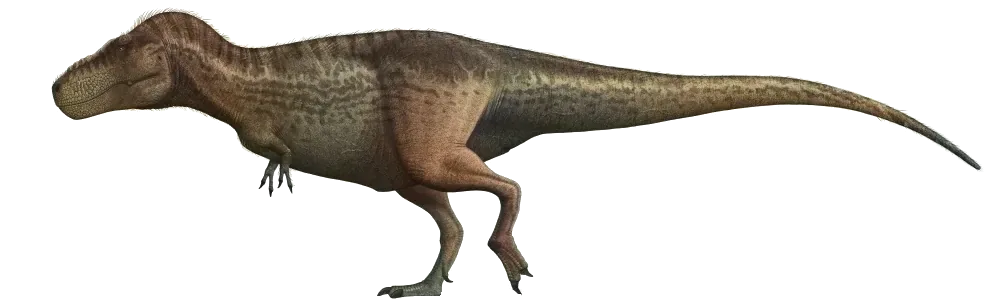
Tyrannosaurus rex war einer der grössten Fleischfresser, die je an Land gelebt haben. Er lebte am Ende der Kreidezeit im Westen Nordamerikas, kurz vor dem grossen Aussterben. Sein Biss war der stärkste, der für ein Landtier berechnet wurde. Mit den Vögeln ist er weitläufig verwandt, denn beide gehören zu den Theropoden.Tyrannosaurus rex was one of the largest meat-eaters ever to live on land. It lived at the very end of the Cretaceous in western North America, shortly before the great extinction. Its bite is the strongest ever calculated for a land animal. It is a distant relative of birds, as both belong to the theropods.
Mehr InformationenMore information
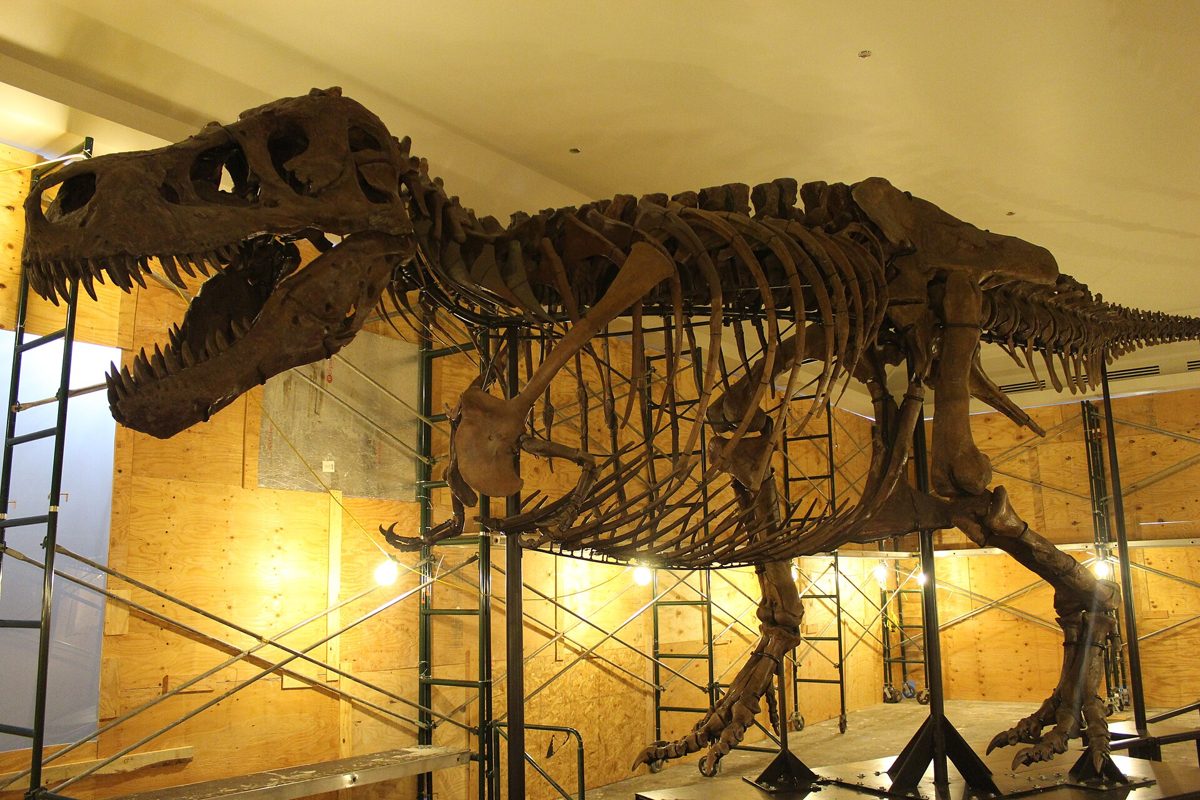
T. rex ist eine der am besten untersuchten Dinosaurierarten, weil viele, teils sehr vollständige Skelette bekannt sind. Das berühmteste ist «Sue» im Field Museum in Chicago: Das Skelett ist nach Knochenvolumen zu rund 90 Prozent erhalten, misst etwa 12.3 Meter und ist an der Hüfte etwa 4 Meter hoch. Das Tier starb mit etwa 28 Jahren.T. rex is one of the best-studied dinosaur species because many skeletons are known, some of them very complete. The most famous is "SUE" at the Field Museum in Chicago: about 90 percent of the skeleton by bone volume is preserved, it is about 12.3 metres long and about 4 metres tall at the hip. The animal died at around 28 years of age.
Wie schwer T. rex war, hängt stark von der Methode ab. Hutchinson und Kollegen schätzten 2011 mit 3D-Modellen für erwachsene Tiere etwa 6 bis 8 Tonnen und für Sue rund 9.5 Tonnen. Knochenschnitte zeigen, dass T. rex in seiner stärksten Wachstumsphase bis zu 2.1 Kilogramm pro Tag zulegte und nach etwa zwei Jahrzehnten ausgewachsen war.How heavy T. rex was depends strongly on the method. Using 3D models, Hutchinson and colleagues estimated in 2011 about 6 to 8 tonnes for adults and around 9.5 tonnes for SUE. Bone sections show that during its fastest growth phase T. rex gained up to 2.1 kilograms per day and was fully grown after about two decades.
Der Kiefer war auf enorme Kraft ausgelegt: Computermodelle ergeben an einem hinteren Zahn eine Beisskraft von 35'000 bis 57'000 Newton. Bei der Geschwindigkeit sind sich Fachleute weniger einig. Eine Studie von 2017 kam zum Schluss, dass die Knochen beim echten Rennen zu stark belastet worden wären und T. rex daher wohl nur schnell gehen konnte. Hautabdrücke zeigen an mehreren Körperstellen Schuppen, obwohl manche frühe Verwandte gefiedert waren.Its jaws were built for enormous force: computer models give a bite force of 35,000 to 57,000 newtons at a rear tooth. Experts agree less on its speed. A 2017 study concluded that true running would have overloaded its bones, so T. rex could probably only walk fast. Skin impressions show scales on several parts of the body, even though some early relatives had feathers.
Wusstest du?Did you know?
- Sue war beim Tod etwa 28 Jahre alt, so alt wie kaum ein anderer bekannter T. rex.SUE was about 28 years old at death, older than almost any other known T. rex.2,5
- In der stärksten Wachstumsphase legte T. rex bis zu 2.1 kg pro Tag zu.During its fastest growth phase T. rex gained up to 2.1 kg per day.5
- Die berechnete Beisskraft von 35'000 bis 57'000 Newton ist die höchste, die für ein Landtier geschätzt wurde.Its calculated bite force of 35,000 to 57,000 newtons is the highest estimated for any land animal.6
- Hautabdrücke zeigen Schuppen, obwohl frühe Verwandte wie Yutyrannus Federn hatten.Skin impressions show scales, even though early relatives such as Yutyrannus had feathers.8
- Das Skelett von Sue ist nach Knochenvolumen zu rund 90 Prozent vollständig.SUE's skeleton is about 90 percent complete by bone volume.2
Was man nicht sicher weissWhat we don’t know for sure
- Wie schnell T. rex war: Neuere Modelle sprechen eher für schnelles Gehen als für Rennen, ältere Studien kamen auf höhere Werte.How fast T. rex was: newer models suggest fast walking rather than running; older studies gave higher values.7,14
- Wie schwer er war: Je nach Methode liegen die Schätzungen für Erwachsene zwischen etwa 6 und 9.5 Tonnen.How heavy it was: depending on the method, estimates for adults range from about 6 to 9.5 tonnes.3
- Ob es nur eine Art gab: 2022 wurde vorgeschlagen, T. rex in drei Arten aufzuteilen. Andere Fachleute halten die Belege dafür für unzureichend.Whether there was only one species: in 2022 it was proposed to split T. rex into three species. Other experts consider the evidence insufficient.9,10
- Ob T. mcraeensis wirklich eine eigene Art ist, wird ebenfalls diskutiert.Whether T. mcraeensis really is a separate species is also debated.11,14
- Wie viel des Körpers beschuppt war: Hautabdrücke sind nur von kleinen Stellen bekannt.How much of the body was scaly: skin impressions are known only from small patches.8
VerwandtschaftRelationships
T. rex gehört zu den Tyrannosauriden, einer Familie grosser Theropoden. Sehr nah verwandt ist der asiatische Tarbosaurus. 2024 wurde der ältere Tyrannosaurus mcraeensis aus New Mexico beschrieben und als Schwesterart von T. rex gedeutet.T. rex belongs to the tyrannosaurids, a family of large theropods. The Asian Tarbosaurus is a very close relative. In 2024 the older Tyrannosaurus mcraeensis from New Mexico was described and interpreted as the sister species of T. rex.14,11
SteckbriefKey facts
- LängeLength
- 12.3–13 m12.3–13 m2,14Sue: 12.3 m; das Exemplar «Scotty» wird auf rund 13 m geschätzt.SUE: 12.3 m; the specimen "Scotty" is estimated at about 13 m.
- GewichtWeight
- 6–9.5 t6–9.5 t3,2Erwachsene meist 6–8 t, Sue bis ca. 9.5 t. Stark abhängig von der Schätzmethode.Adults mostly 6–8 t, SUE up to about 9.5 t. Strongly depends on the estimation method.
- ZeitraumTime range
- 69–66 Mio. Jahre69–66 million years ago2,14Sue ist rund 67 Mio. Jahre alt. Ältere Einzelfunde sind umstritten.SUE is about 67 million years old. Older isolated finds are disputed.
- ErnährungDiet
- FleischfresserCarnivore6,14Jäger, der wohl auch Aas nicht verschmähte.A predator that probably also scavenged.
- FortbewegungLocomotion
- zweibeinigtwo-legged7Wahrscheinlich nur schnelles Gehen, kein echtes Rennen.Probably fast walking only, no true running.
FundorteFossil sites
- Montana, USAMontana, USA12,13Hell Creek Formation
- South Dakota, USA (Fundort von Sue)South Dakota, USA (site of SUE)2,14Hell Creek Formation
- Saskatchewan, Kanada (Fundort von «Scotty»)Saskatchewan, Canada (site of "Scotty")4,14Frenchman Formation
- weitere Fundorte in Wyoming, North Dakota und Albertafurther sites in Wyoming, North Dakota and Alberta14
EntdeckungDiscovery1,12,13,2,14
- JahrYear
- 1902
- OrtPlace
- bei Jordan, Montana, USAnear Jordan, Montana, USA
- Beschrieben vonDescribed by
- Henry Fairfield Osborn (1905)
- FundSpecimen
- Holotyp CM 9380 (früher AMNH 973)
Gefunden von Barnum Brown. Bekanntester Fund: «Sue» (FMNH PR 2081), 1990 von Sue Hendrickson in South Dakota entdeckt.Found by Barnum Brown. Best-known find: "SUE" (FMNH PR 2081), discovered in 1990 by Sue Hendrickson in South Dakota.
Berühmter FundFamous specimen
Wo gefundenWhere it was found
Lage von Jordan, MontanaLocation of Jordan, Montana15 · FundkarteDiscovery map →
GrössenvergleichSize comparison
QuellenSources
- Osborn, H. F. (1905): Tyrannosaurus and other Cretaceous carnivorous dinosaurs. Bulletin of the American Museum of Natural History 21
- Field Museum (2016): How well do you know SUE?
- Hutchinson, J. R. et al. (2011): A computational analysis of limb and body dimensions in Tyrannosaurus rex. PLoS ONE 6(10)
- Persons, W. S., Currie, P. J. & Erickson, G. M. (2019): An older and exceptionally large adult specimen of Tyrannosaurus rex. The Anatomical Record 303
- Erickson, G. M. et al. (2004): Gigantism and comparative life-history parameters of tyrannosaurid dinosaurs. Nature 430
- Bates, K. T. & Falkingham, P. L. (2012): Estimating maximum bite performance in Tyrannosaurus rex using multi-body dynamics. Biology Letters 8
- Sellers, W. I. et al. (2017): Investigating the running abilities of Tyrannosaurus rex using stress-constrained multibody dynamic analysis. PeerJ 5
- Bell, P. R. et al. (2017): Tyrannosauroid integument reveals conflicting patterns of gigantism and feather evolution. Biology Letters 13
- Paul, G. S., Persons, W. S. & Van Raalte, J. (2022): The Tyrant Lizard King, Queen and Emperor. Evolutionary Biology 49
- Carr, T. D. et al. (2022): Insufficient evidence for multiple species of Tyrannosaurus in the latest Cretaceous of North America. Evolutionary Biology 49
- Dalman, S. G. et al. (2024): A giant tyrannosaur from the Campanian–Maastrichtian of southern North America. Scientific Reports 14
- American Museum of Natural History: Field letters, 1902 Cretaceous of Montana (Barnum Brown)
- Carnegie Museum of Natural History: Tyrannosaurus rex
- Wikipedia: Tyrannosaurus (secondary source, accessed October 2026)
- Wikipedia: Jordan, Montana (coordinates, accessed October 2026)