SilesaurusSilesaurus
Silesaurus opolensis
Umstritten: Einordnung oder Deutung werden in der Forschung diskutiert.Contested: its classification or interpretation is debated by researchers.
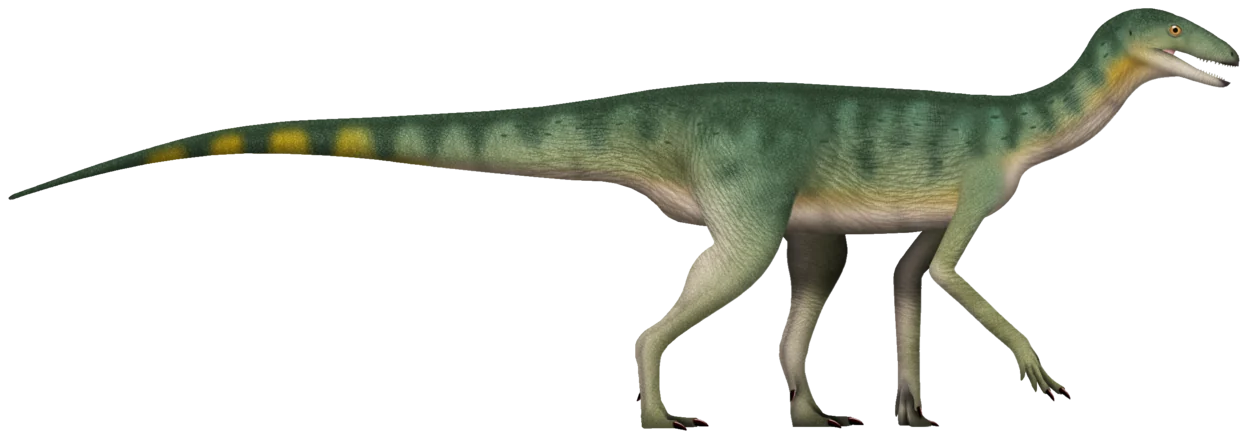
Silesaurus war ein schlanker, etwa 2.3 Meter langer Verwandter der Dinosaurier aus der späten Trias Polens. Er lief wohl auf vier langen, dünnen Beinen und hatte vorne am Unterkiefer einen Hornschnabel. Ob er selbst ein früher Dinosaurier war oder knapp daneben steht, ist umstritten. In seinem Kot fanden sich Käfer.Silesaurus was a slender, roughly 2.3-metre-long relative of the dinosaurs from the Late Triassic of Poland. It probably walked on four long, thin legs and had a horny beak at the front of its lower jaw. Whether it was itself an early dinosaur or sits just outside is disputed. Beetles have been found in its dung.
Mehr InformationenMore information
In der Tongrube von Krasiejów bei Opole in Polen stiessen Arbeiter in den 1980er-Jahren auf Fossilien. Bei Grabungen von 2000 bis 2002 kamen fast 400 Knochen eines einzigen Tiers zum Vorschein, darunter vier Teilskelette. Jerzy Dzik beschrieb es 2003 als Silesaurus opolensis.In the 1980s workers in the Krasiejów clay pit near Opole, Poland, came across fossils. Excavations from 2000 to 2002 uncovered almost 400 bones of a single animal, including four partial skeletons. Jerzy Dzik described it in 2003 as Silesaurus opolensis.
Silesaurus war leicht gebaut und wohl schnell und wendig. Die Augen waren gross, die Zähne klein und kegelförmig, die Unterkieferspitze zahnlos und wohl mit Horn bedeckt. Er hat einige typische Dinosaurier-Merkmale am Becken und Bein, andere fehlen ihm, etwa ein grosser Muskelkamm am Oberarm.Silesaurus was lightly built and probably fast and agile. Its eyes were large, its teeth small and conical, and the tip of its lower jaw toothless and probably covered in horn. It has some typical dinosaur features in the hip and leg, but lacks others, such as a large muscle crest on the upper arm.
Lange galt er als Pflanzenfresser. 2019 wurden Koprolithen mit vielen Käfern beschrieben, die wohl von Silesaurus stammen. Er pickte vielleicht Insekten vom Boden wie heutige Vögel, frass aber wohl auch Pflanzen. Eine grosse Analyse von 2011 sieht die Silesauriden als nächste Verwandte der Dinosaurier; andere Forschende halten sie für frühe Ornithischier.For a long time it was thought to be a plant-eater. In 2019 coprolites full of beetles were described that probably come from Silesaurus. It may have pecked insects off the ground like today's birds, but probably also ate plants. A large analysis in 2011 sees the silesaurids as the closest relatives of dinosaurs; other researchers consider them early ornithischians.
Silesaurus lebte in einem subtropischen Gebiet mit Sommermonsun und trockenen Wintern, ähnlich dem heutigen Mittelmeerraum. Sümpfe und Farne prägten die Landschaft; dort lebten auch Lungenfische, grosse Amphibien, Phytosaurier und frühe Flugsaurier. Eine Studie von 2020 fand, dass seine Hinterbeine säulenartig unter dem Körper standen, ähnlich wie bei manchen Krokodilverwandten der Trias.Silesaurus lived in a subtropical region with summer monsoons and dry winters, similar to today's Mediterranean. Swamps and ferns shaped the landscape; lungfish, large amphibians, phytosaurs and early pterosaurs lived there too. A 2020 study found that its hind legs stood like pillars under the body, similar to some Triassic crocodile relatives.
Wusstest du?Did you know?
- Aus einer einzigen Fundschicht stammen fast 400 Knochen von Silesaurus.Almost 400 bones of Silesaurus come from a single layer.4
- In Koprolithen, die ihm zugeordnet werden, stecken viele Käfer.Coprolites attributed to it contain many beetles.3
- Er hatte vorne am Unterkiefer wohl einen Hornschnabel.It probably had a horny beak at the front of its lower jaw.1,4
- Um einen Teil der Fundstelle wurde ein Museum gebaut, in dem man die Grabung sehen kann.A museum was built around part of the site, where visitors can watch the excavation.4
- Einige Funde hielt man zuerst für Reste eines Herrerasauriers, also eines frühen Raubdinosauriers.Some finds were at first thought to belong to a herrerasaurid, an early predatory dinosaur.4
Was man nicht sicher weissWhat we don’t know for sure
- Ob Silesaurus ein früher Ornithischier und damit ein Dinosaurier war oder ein naher Verwandter ausserhalb der Dinosaurier.Whether Silesaurus was an early ornithischian, and thus a dinosaur, or a close relative outside the dinosaurs.4,5
- Wie viel er an Pflanzen und wie viel an Insekten frass.How much of its diet was plants and how much insects.2,3
- Ob Silesaurus nur auf vier Beinen ging oder zeitweise auch auf zwei rennen konnte.Whether Silesaurus only walked on four legs or could sometimes run on two.4,7
VerwandtschaftRelationships
Silesaurus gehört zu den Silesauriden. Nach Nesbitt (2011) sind sie die nächsten Verwandten der Dinosaurier; andere Studien stellen sie an die Basis der Ornithischier.Silesaurus belongs to the silesaurids. According to Nesbitt (2011) they are the closest relatives of dinosaurs; other studies place them at the base of the Ornithischia.4,5
SteckbriefKey facts
- LängeLength
- ca. 2.3 mapprox. 2.3 m4
- ZeitraumTime range
- 237–227.3 Mio. Jahre237–227.3 million years ago4Karnium (späte Trias).Carnian (Late Triassic).
- ErnährungDiet
- AllesfresserOmnivore2,3Pflanzen und wohl auch Insekten wie Käfer.Plants and probably also insects such as beetles.
- FortbewegungLocomotion
- vierbeinigfour-legged4
FundorteFossil sites
EntdeckungDiscovery1,4
- JahrYear
- unbekanntunknown
- OrtPlace
- Krasiejów bei Opole, PolenKrasiejów near Opole, Poland
- Beschrieben vonDescribed by
- Jerzy Dzik (2003)
- FundSpecimen
- ZPAL Ab III/361 (Holotyp)
Ausgegraben 2000 bis 2002.Excavated from 2000 to 2002.
Wo gefundenWhere it was found
Lage von KrasiejówLocation of Krasiejów6 · FundkarteDiscovery map →
GrössenvergleichSize comparison
QuellenSources
- Dzik, J. (2003): A beaked herbivorous archosaur with dinosaur affinities from the early Late Triassic of Poland. Journal of Vertebrate Paleontology 23
- Kubo, T. & Kubo, M. O. (2013): Dental microwear of a Late Triassic dinosauriform, Silesaurus opolensis. Acta Palaeontologica Polonica
- Qvarnström, M. et al. (2019): Beetle-bearing coprolites possibly reveal the diet of a Late Triassic dinosauriform. Royal Society Open Science 6
- Wikipedia: Silesaurus (secondary source, accessed October 2026)
- Nesbitt, S. J. (2011): The early evolution of archosaurs: relationships and the origin of major clades. Bulletin of the American Museum of Natural History 352
- Wikipedia: Krasiejów (coordinates, accessed October 2026)
- Piechowski, R. & Tałanda, M. (2020): The locomotor musculature and posture of the early dinosauriform Silesaurus opolensis provides a new look into the evolution of Dinosauromorpha. Journal of Anatomy 236