ParasaurolophusParasaurolophus
Parasaurolophus walkeri
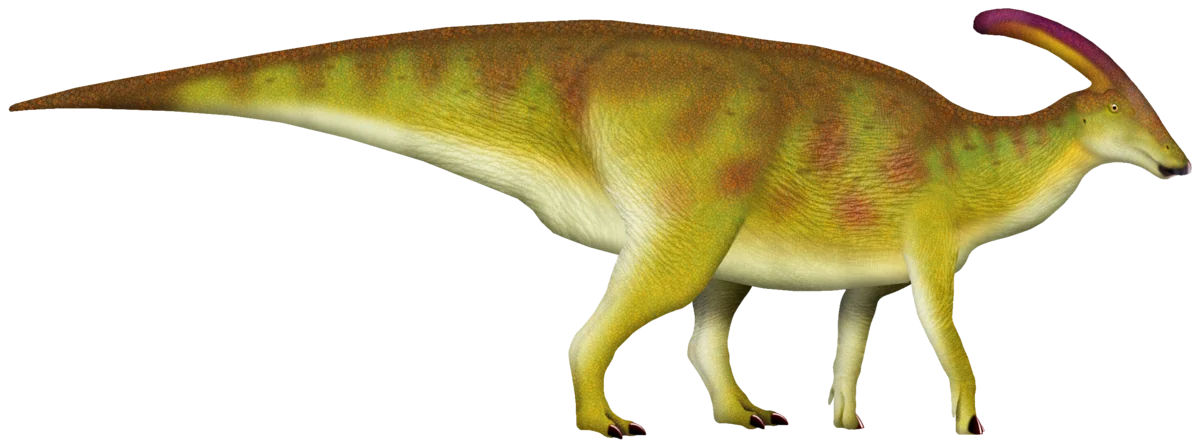
Parasaurolophus war ein Entenschnabelsaurier aus der späten Kreidezeit Nordamerikas. Berühmt ist sein langer, nach hinten gebogener Knochenkamm auf dem Kopf, der innen hohl war. Damit konnte er wohl tiefe Töne erzeugen. Er wurde etwa 7.5 bis 9.5 Meter lang und ging auf zwei oder vier Beinen.Parasaurolophus was a duck-billed dinosaur from the Late Cretaceous of North America. It is famous for the long, backward-curving bony crest on its head, which was hollow inside. It could probably use it to make deep sounds. It grew to about 7.5 to 9.5 metres long and walked on two or four legs.
Mehr InformationenMore information
Ein Team der Universität Toronto fand 1920 am Red Deer River in Alberta, Kanada, einen Schädel mit Teilskelett. William Parks beschrieb ihn 1922 als Parasaurolophus walkeri. Später kamen zwei weitere Arten aus New Mexico und Utah hinzu: P. tubicen und die kurzkammige P. cyrtocristatus. Parasaurolophus ist selten; es gibt nur wenige gute Funde.In 1920 a team from the University of Toronto found a skull and partial skeleton on the Red Deer River in Alberta, Canada. William Parks described it in 1922 as Parasaurolophus walkeri. Two more species were later added from New Mexico and Utah: P. tubicen and the short-crested P. cyrtocristatus. Parasaurolophus is rare; there are only a few good finds.
Der Kamm wird von den Nasenbeinen gebildet. In ihm verlaufen die Atemwege als lange Röhren. Untersuchungen dieser Röhren deuten darauf hin, dass der Kamm als Resonanzraum für tiefe Laute diente, ähnlich einem Blasinstrument. Daneben diente er wohl dazu, Artgenossen zu erkennen. Ein Jungtier aus Utah zeigt, dass der Kamm schon früh im Leben zu wachsen begann.The crest is formed by the nasal bones. The airways run through it as long tubes. Studies of these tubes suggest that the crest acted as a resonating chamber for deep sounds, much like a wind instrument. It probably also helped animals recognise their own species. A young animal from Utah shows that the crest began to grow early in life.
Der Holotyp von P. walkeri wird auf etwa 9.5 Meter Länge geschätzt; ein Tier dieser Grösse wog wohl über 5 Tonnen. Mit seinem breiten Schnabel und vielen Mahlzähnen frass er Pflanzen. Wie andere Hadrosaurier suchte er seine Nahrung wohl auf allen vieren und lief auf zwei Beinen.The holotype of P. walkeri is estimated at about 9.5 metres long; an animal of this size probably weighed more than 5 tonnes. With its broad beak and many grinding teeth it ate plants. Like other hadrosaurs it probably foraged on all fours and ran on two legs.
Wusstest du?Did you know?
- Der Name bedeutet «neben der Kammechse», in Anspielung auf den Verwandten Saurolophus.The name means "near crested lizard", referring to its relative Saurolophus.4
- Der Artname tubicen der zweiten Art bedeutet «Trompeter».The species name tubicen of the second species means "trumpeter".4
- Der Kamm war innen hohl: Die Atemwege liefen als lange Röhren hindurch.The crest was hollow: the airways ran through it as long tubes.2,4
- Das kleinste bekannte Jungtier war etwa 2.5 Meter lang und wohl noch kein Jahr alt.The smallest known young animal was about 2.5 metres long and probably less than a year old.3
- Der Schädel des Holotyps ist mitsamt Kamm etwa 1.6 Meter lang.The skull of the holotype, crest included, is about 1.6 metres long.4
Was man nicht sicher weissWhat we don’t know for sure
- Wofür der Kamm vor allem diente: Töne, Erkennen von Artgenossen oder Temperaturregelung.What the crest was mainly for: sounds, recognising its own kind or regulating temperature.2,4
- Ob die kurzkammige Form eine eigene Art ist oder Weibchen zeigt.Whether the short-crested form is a separate species or represents females.2,4
- Ob die chinesische Gattung Charonosaurus eigentlich zu Parasaurolophus gehört.Whether the Chinese genus Charonosaurus actually belongs to Parasaurolophus.4
VerwandtschaftRelationships
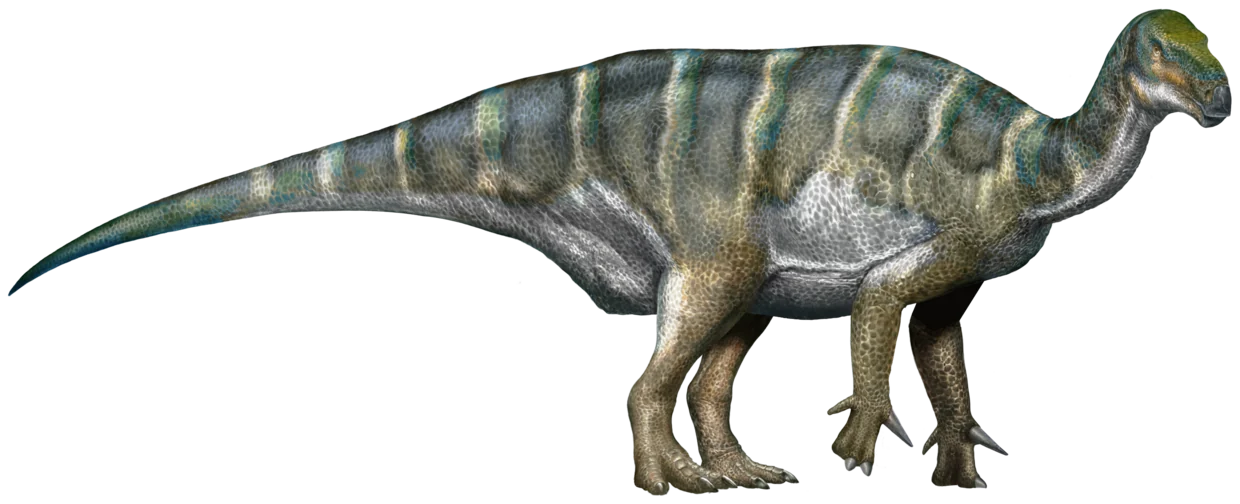
Parasaurolophus gehört zu den Lambeosaurinen, den hohlkammigen Entenschnabelsauriern (Hadrosauriden). Diese stammen von Ornithopoden ab, zu denen auch Iguanodon gehört.Parasaurolophus belongs to the lambeosaurines, the hollow-crested duck-billed dinosaurs (hadrosaurids). These descend from ornithopods, a group that also includes Iguanodon.4
SteckbriefKey facts
- LängeLength
- 7.5–9.5 m7.5–9.5 m4Mittleres Erwachsenes laut Gregory S. Paul bis Schätzung für den Holotyp.From an average adult according to Gregory S. Paul to the estimate for the holotype.
- GewichtWeight
- 2.6–5 t2.6–5 t4Schätzungen gehen weit auseinander.Estimates vary widely.
- ZeitraumTime range
- 76.5–73 Mio. Jahre76.5–73 million years ago1,4Campanium (späte Kreide). Ein mögliches jüngeres Vorkommen ist unsicher.Campanian (Late Cretaceous). A possible younger occurrence is uncertain.
- ErnährungDiet
- PflanzenfresserHerbivore4
- FortbewegungLocomotion
- meist vierbeinig, teils zweibeinigmostly four-legged, sometimes two-legged4Frass wohl auf vier Beinen, lief auf zwei.Probably fed on four legs and ran on two.
FundorteFossil sites
EntdeckungDiscovery4
- JahrYear
- 1920
- OrtPlace
- Sand Creek am Red Deer River, Alberta, KanadaSand Creek on the Red Deer River, Alberta, Canada
- Beschrieben vonDescribed by
- William Parks (1922)
- FundSpecimen
- Holotyp ROM 768
Gefunden von einem Team der Universität Toronto.Found by a team from the University of Toronto.
Wo gefundenWhere it was found
Ungefähre Lage, nur die Region ist angegeben: Dinosaur Provincial ParkApproximate location, only the region is given: Dinosaur Provincial Park5 · FundkarteDiscovery map →
GrössenvergleichSize comparison
QuellenSources
- Evans, D. C., Bavington, R. & Campione, N. E. (2009): An unusual hadrosaurid braincase from the Dinosaur Park Formation and the biostratigraphy of Parasaurolophus from southern Alberta. Canadian Journal of Earth Sciences 46
- Weishampel, D. B. (1981): Acoustic analyses of potential vocalization in lambeosaurine dinosaurs (Reptilia: Ornithischia). Paleobiology 7
- Farke, A. A. et al. (2013): Ontogeny in the tube-crested dinosaur Parasaurolophus (Hadrosauridae) and heterochrony in hadrosaurids. PeerJ 1
- Wikipedia: Parasaurolophus (secondary source, accessed October 2026)
- Wikipedia: Dinosaur Provincial Park (coordinates, accessed October 2026)