TriceratopsTriceratops
Triceratops horridus
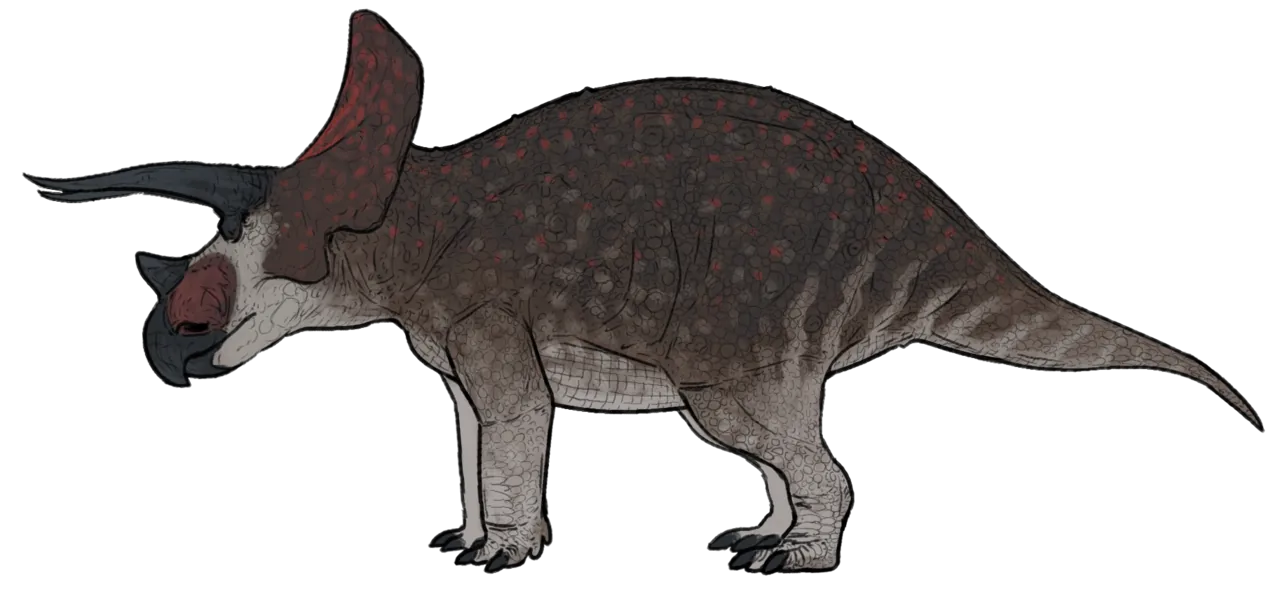
Triceratops war ein grosser Pflanzenfresser mit drei Hörnern und einem breiten Knochenschild im Nacken. Er lebte ganz am Ende der Kreidezeit im Westen Nordamerikas, zur selben Zeit wie Tyrannosaurus rex. Mit seinem Schnabel und Hunderten von Zähnen konnte er zähe Pflanzen gut zerkleinern. Wofür Hörner und Nackenschild genau dienten, ist bis heute nicht ganz geklärt.Triceratops was a large plant-eater with three horns and a broad bony frill at the back of its head. It lived at the very end of the Cretaceous in western North America, at the same time as Tyrannosaurus rex. With its beak and hundreds of teeth it could process tough plants well. What exactly its horns and frill were used for is still not fully settled.
Mehr InformationenMore information
Triceratops gehört zu den Ceratopsiden, den Horndinosauriern, und innerhalb dieser zu den Chasmosaurinen. Der Name bedeutet «Dreihorngesicht». Othniel Charles Marsh beschrieb die Gattung 1889 anhand eines Schädels, den John Bell Hatcher 1888 in der Lance-Formation in Wyoming geborgen hatte. Heute gelten meist zwei Arten als gültig: T. horridus und T. prorsus.Triceratops belongs to the ceratopsids, the horned dinosaurs, and within them to the chasmosaurines. The name means "three-horned face". Othniel Charles Marsh described the genus in 1889 based on a skull that John Bell Hatcher had recovered from the Lance Formation in Wyoming in 1888. Today two species are usually considered valid: T. horridus and T. prorsus.
Triceratops war mit etwa 8 bis 9 Metern Länge einer der grössten Horndinosaurier. Seine Zähne sassen in sogenannten Zahnbatterien: dicht gepackte Reihen, in denen ständig neue Zähne nachwuchsen. Eine Studie von 2015 zeigte, dass sich die Zähne beim Kauen so abnutzten, dass Rinnen entstanden, die die Reibung verringerten. Das spricht dafür, dass Triceratops grosse Mengen faseriger Pflanzen frass.At about 8 to 9 metres long, Triceratops was one of the largest horned dinosaurs. Its teeth sat in so-called dental batteries: densely packed rows in which new teeth constantly grew in. A 2015 study showed that the teeth wore during chewing in a way that formed grooves which reduced friction. This suggests that Triceratops ate large amounts of fibrous plants.
Die Funktion von Hörnern und Nackenschild ist umstritten. Verheilte Verletzungen am Nackenschild passen dazu, dass Triceratops seine Hörner im Kampf mit Artgenossen einsetzte. Gleichzeitig dienten sie wahrscheinlich auch zur Schau. Bissspuren von Tyrannosaurus an Triceratops-Knochen zeigen, dass er zur Beute oder zumindest zur Nahrung dieses Räubers gehörte. Ob der verwandte Torosaurus nur ein voll ausgewachsener Triceratops ist, wird seit 2010 diskutiert.The function of the horns and frill is debated. Healed injuries on the frill fit the idea that Triceratops used its horns in combat with its own kind. At the same time, they were probably also used for display. Tyrannosaurus bite marks on Triceratops bones show that it was prey, or at least food, for this predator. Whether the related Torosaurus is simply a fully grown Triceratops has been debated since 2010.
Wusstest du?Did you know?
- Der Name Triceratops bedeutet «Dreihorngesicht».The name Triceratops means "three-horned face".8
- Marsh hielt 1887 zwei Hornzapfen aus Colorado zuerst für die Reste eines riesigen Bisons und nannte sie Bison alticornis.In 1887 Marsh first took two horn cores from Colorado for the remains of a giant bison and named them Bison alticornis.1,8
- Ein Triceratops hatte je nach Grösse etwa 432 bis 800 Zähne, von denen nur ein Teil gleichzeitig benutzt wurde.Depending on its size, a Triceratops had about 432 to 800 teeth, of which only some were in use at the same time.8
- Die Zähne nutzten sich beim Kauen so ab, dass sie selbst Rinnen bildeten, die die Reibung verringerten.The teeth wore during chewing in a way that formed grooves which reduced friction.3
- Ein Becken von Triceratops trägt zahlreiche Bissspuren von Tyrannosaurus rex.A Triceratops pelvis bears numerous Tyrannosaurus rex bite marks.7,8
Was man nicht sicher weissWhat we don’t know for sure
- Ob Torosaurus eine eigene Gattung oder einfach ein sehr alter Triceratops ist.Whether Torosaurus is a separate genus or simply a very old Triceratops.4,5
- Wofür Hörner und Nackenschild vor allem dienten: Kampf, Verteidigung oder Schau.What the horns and frill were mainly used for: combat, defence or display.6,8
- Wie schwer Triceratops war: Die Schätzungen reichen von etwa 5.4 bis 10 Tonnen.How heavy Triceratops was: estimates range from about 5.4 to 10 tonnes.8
- Ob T. horridus und T. prorsus zwei Arten oder Stufen einer einzigen Entwicklungslinie sind.Whether T. horridus and T. prorsus are two species or stages of a single lineage.8
VerwandtschaftRelationships
Triceratops gehört zu den Ceratopsia (Horndinosaurier) innerhalb der Ornithischia. Innerhalb der Ceratopsiden zählt er zu den Chasmosaurinen. Nahe verwandt ist Torosaurus, der möglicherweise sogar dieselbe Gattung ist.Triceratops belongs to Ceratopsia (horned dinosaurs) within Ornithischia. Among ceratopsids it is a chasmosaurine. A close relative is Torosaurus, which may even be the same genus.8,4,5
SteckbriefKey facts
- Höhe (stehend)Height (standing)
- 2.3–3 m2.3–3 m8Angaben zu einzelnen Skeletten («Kelsey», «Big John»). Unklar, ob Hüft- oder Gesamthöhe.Values for individual skeletons ("Kelsey", "Big John"). Unclear whether hip or overall height.
- GewichtWeight
- 5.4–10 t5.4–10 t8Skelett «Kelsey» ca. 5.4 t; andere Schätzungen 6–10 t.Skeleton "Kelsey" about 5.4 t; other estimates 6–10 t.
- ZeitraumTime range
- 69–66 Mio. Jahre69–66 million years ago8Lebte bis zum Massenaussterben vor 66 Mio. Jahren.Lived until the mass extinction 66 million years ago.
- ErnährungDiet
- PflanzenfresserHerbivore3,8Wohl vor allem niedrig wachsende, faserige Pflanzen.Probably mainly low-growing, fibrous plants.
- FortbewegungLocomotion
- vierbeinigfour-legged8
FundorteFossil sites
- Wyoming, USA (Fundort des Holotyps)Wyoming, USA (holotype site)2,8Lance Formation
- Montana, North und South Dakota, USAMontana, North and South Dakota, USA4,8Hell Creek Formation
- Colorado, USAColorado, USA1,8Denver Formation
- Alberta und Saskatchewan, KanadaAlberta and Saskatchewan, Canada8Scollard Formation u. a.
EntdeckungDiscovery2,8
- JahrYear
- 1888
- OrtPlace
- Lance-Formation, Wyoming, USALance Formation, Wyoming, USA
- Beschrieben vonDescribed by
- Othniel Charles Marsh (1889)
- FundSpecimen
- Holotyp YPM 1820
Gesammelt von John Bell Hatcher. Marsh nannte den Schädel zuerst Ceratops horridus.Collected by John Bell Hatcher. Marsh first named the skull Ceratops horridus.
Wo gefundenWhere it was found
Ungefähre Lage, nur die Region ist angegeben: WyomingApproximate location, only the region is given: Wyoming9 · FundkarteDiscovery map →
GrössenvergleichSize comparison
QuellenSources
- Marsh, O. C. (1887): Notice of new fossil mammals. American Journal of Science s3-34
- Marsh, O. C. (1889): Notice of gigantic horned Dinosauria from the Cretaceous. American Journal of Science s3-38
- Erickson, G. M. et al. (2015): Wear biomechanics in the slicing dentition of the giant horned dinosaur Triceratops. Science Advances 1
- Scannella, J. B. & Horner, J. R. (2010): Torosaurus Marsh, 1891, is Triceratops Marsh, 1889: synonymy through ontogeny. Journal of Vertebrate Paleontology 30
- Longrich, N. R. & Field, D. J. (2012): Torosaurus is not Triceratops. PLoS ONE 7
- Farke, A. A., Wolff, E. D. S. & Tanke, D. H. (2009): Evidence of combat in Triceratops. PLoS ONE 4
- Erickson, G. M. & Olson, K. H. (1996): Bite marks attributable to Tyrannosaurus rex. Journal of Vertebrate Paleontology 16
- Wikipedia: Triceratops (secondary source, accessed October 2026)
- Wikipedia: Wyoming (coordinates, accessed October 2026)