IguanodonIguanodon
Iguanodon bernissartensis
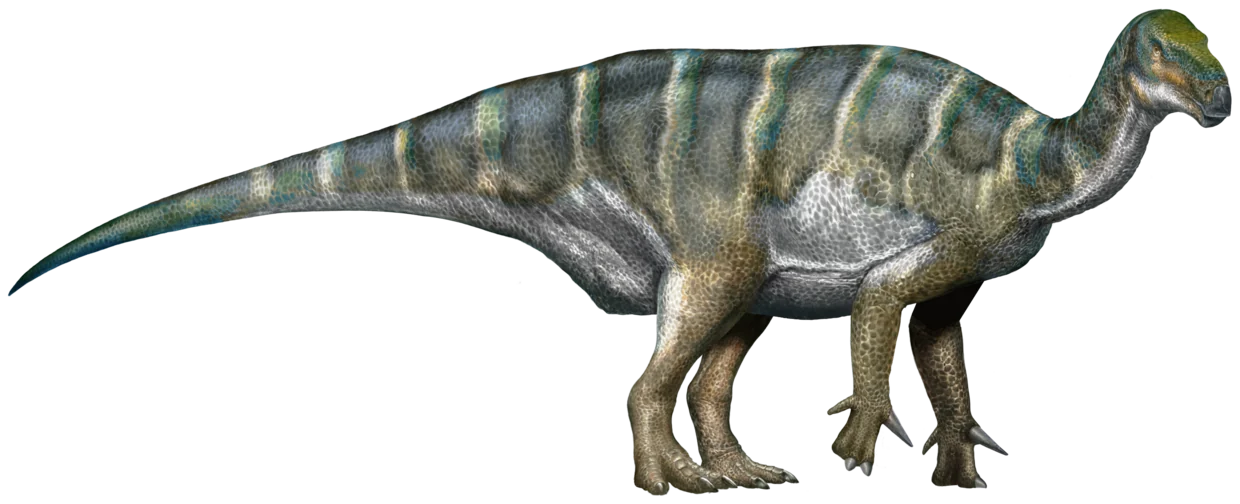
Iguanodon war ein grosser Pflanzenfresser aus der frühen Kreidezeit Europas. Er wurde etwa 9 bis 11 Meter lang und konnte auf zwei oder auf vier Beinen gehen. Auffällig sind die spitzen Daumenstacheln. Iguanodon war einer der ersten Dinosaurier, die die Wissenschaft überhaupt benannt hat.Iguanodon was a large plant-eater from the Early Cretaceous of Europe. It grew to about 9 to 11 metres long and could walk on two or four legs. Its pointed thumb spikes are striking. Iguanodon was one of the very first dinosaurs ever named by science.
Mehr InformationenMore information
Gideon Mantell benannte Iguanodon 1825 nach Zähnen aus Sussex in England, die denen eines Leguans ähnelten, nur viel grösser. Nach Megalosaurus war es der zweite formell benannte Dinosaurier. 1878 stiessen Bergleute in einer Kohlemine bei Bernissart in Belgien in 322 Metern Tiefe auf Skelette. Mindestens 38 Tiere wurden geborgen. Louis Dollo setzte sie ab 1882 zusammen; sie stehen heute im Museum in Brüssel.Gideon Mantell named Iguanodon in 1825 after teeth from Sussex, England, that resembled those of an iguana, only much larger. It was the second dinosaur formally named, after Megalosaurus. In 1878 miners in a coal mine near Bernissart, Belgium, came across skeletons at a depth of 322 metres. At least 38 animals were recovered. Louis Dollo assembled them from 1882; they now stand in the museum in Brussels.
Die einzige gut belegte Art, Iguanodon bernissartensis, wurde etwa 9 bis 11 Meter lang und wohl rund 4 Tonnen schwer. Die Arme waren lang und kräftig, die drei mittleren Finger trugen Gewicht. Der Daumen war ein kegelförmiger Stachel, der kleine Finger lang und beweglich. Frühe Rekonstruktionen setzten den Stachel fälschlich auf die Nase.The only well-supported species, Iguanodon bernissartensis, grew to about 9 to 11 metres long and probably weighed around 4 tonnes. Its arms were long and strong, and the three middle fingers bore weight. The thumb was a conical spike, the little finger long and flexible. Early reconstructions wrongly placed the spike on the nose.
Iguanodon hatte einen zahnlosen Schnabel und dahinter dicht stehende Mahlzähne. Beim Schliessen bogen sich die Oberkiefer leicht nach aussen, sodass die Zähne Pflanzen zerrieben, ähnlich wie beim Kauen von Säugetieren. Viele früher zu Iguanodon gezählte Arten aus England stehen heute in eigenen Gattungen wie Mantellisaurus.Iguanodon had a toothless beak with closely packed grinding teeth behind it. When the jaws closed, the upper jaws bowed slightly outwards, so the teeth ground up plants, much like chewing in mammals. Many species from England once placed in Iguanodon are now in separate genera such as Mantellisaurus.
Wusstest du?Did you know?
- Der Name bedeutet «Leguanzahn».The name means "iguana tooth".1,4
- Der Daumenstachel wurde in frühen Rekonstruktionen auf die Nase gesetzt.In early reconstructions the thumb spike was placed on the nose.4
- In einer belgischen Kohlemine fanden Bergleute 1878 mindestens 38 Skelette, in 322 Metern Tiefe.In 1878 miners found at least 38 skeletons in a Belgian coal mine, 322 metres underground.4
- Iguanodon war einer der drei Dinosaurier, mit denen Richard Owen 1842 die Gruppe Dinosauria begründete.Iguanodon was one of the three dinosaurs Richard Owen used to define the group Dinosauria in 1842.4
- Ein Bernissart-Skelett wurde 1882 als eines der ersten Dinosaurierskelette überhaupt aufgestellt.In 1882 a Bernissart skeleton became one of the very first dinosaur skeletons ever mounted.4
Was man nicht sicher weissWhat we don’t know for sure
VerwandtschaftRelationships
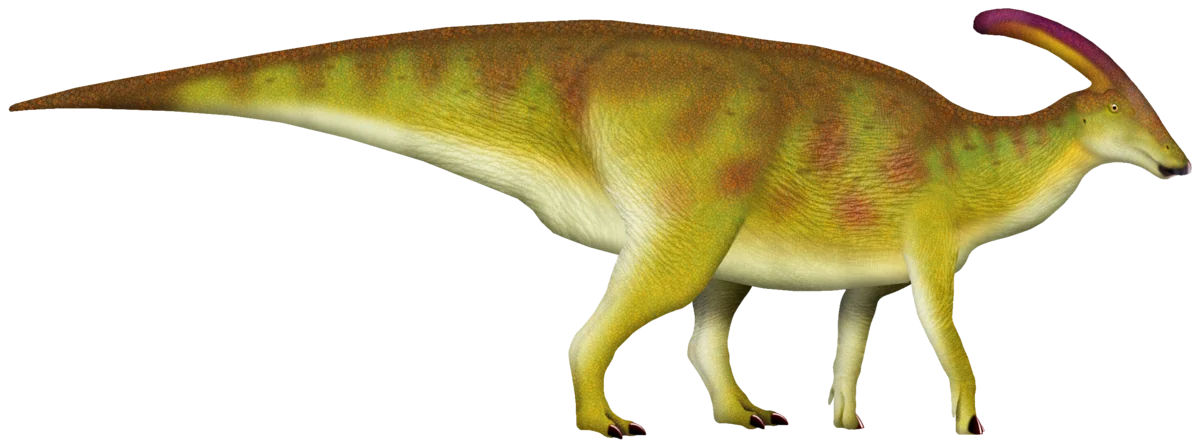
Iguanodon gehört zu den Ornithopoden, den «Vogelfuss»-Dinosauriern. Er ist verwandt mit den Entenschnabelsauriern (Hadrosauriern) wie Parasaurolophus.Iguanodon belongs to the ornithopods, the "bird-footed" dinosaurs. It is related to the duck-billed dinosaurs (hadrosaurs) such as Parasaurolophus.4
SteckbriefKey facts
- LängeLength
- 9–11 m9–11 m2,4Erwachsene Tiere; 11 m gilt als Höchstwert.Adult animals; 11 m is considered the maximum.
- GewichtWeight
- 3.8–4.5 t3.8–4.5 t4Modellschätzungen; Gregory S. Paul nahm im Mittel etwa 3.1 t an.Model estimates; Gregory S. Paul suggested about 3.1 t on average.
- ZeitraumTime range
- 126–122 Mio. Jahre126–122 million years ago4Barremium bis frühes Aptium (frühe Kreide).Barremian to early Aptian (Early Cretaceous).
- FortbewegungLocomotion
- meist vierbeinig, teils zweibeinigmostly four-legged, sometimes two-legged4Konnte zwischen zwei und vier Beinen wechseln.Could switch between two and four legs.
FundorteFossil sites
EntdeckungDiscovery1,4
- JahrYear
- 1878
- OrtPlace
- Kohlemine bei Bernissart, BelgienCoal mine near Bernissart, Belgium
- Beschrieben vonDescribed by
- George Albert Boulenger (Art, 1881)
- FundSpecimen
- IRSNB 1534 (Holotyp der Art)
Die Gattung benannte Gideon Mantell schon 1825 nach Zähnen aus England. Seit 2000 ist I. bernissartensis die Typusart.Gideon Mantell had already named the genus in 1825 after teeth from England. Since 2000 I. bernissartensis has been the type species.
Wo gefundenWhere it was found
Lage von BernissartLocation of Bernissart5 · FundkarteDiscovery map →
GrössenvergleichSize comparison
QuellenSources
- Mantell, G. A. (1825): Notice on the Iguanodon, a newly discovered fossil reptile, from the sandstone of Tilgate forest, in Sussex. Philosophical Transactions of the Royal Society 115
- Verdú, F. J. et al. (2017): Individual variation in the postcranial skeleton of the Early Cretaceous Iguanodon bernissartensis (Dinosauria: Ornithopoda). Cretaceous Research 74
- Naish, D. & Martill, D. M. (2008): Dinosaurs of Great Britain and the role of the Geological Society of London in their discovery: Ornithischia. Journal of the Geological Society 165
- Wikipedia: Iguanodon (secondary source, accessed October 2026)
- Wikipedia: Bernissart (coordinates, accessed October 2026)