DiplodocusDiplodocus
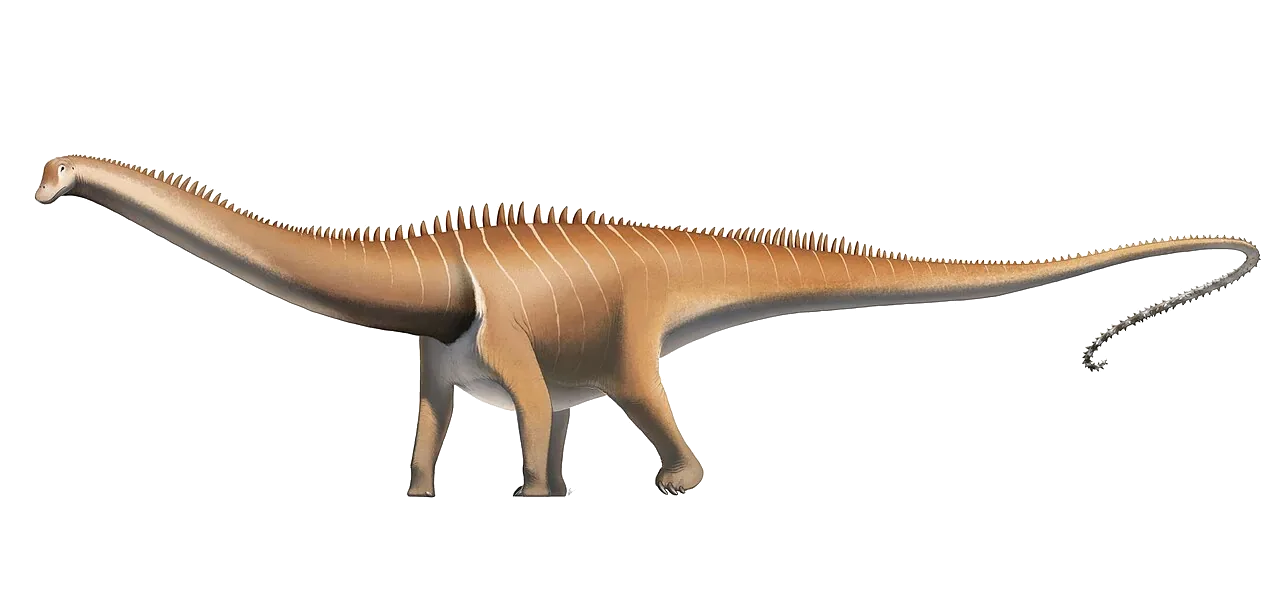
Diplodocus war ein riesiger Pflanzenfresser mit sehr langem Hals und einem noch längeren, peitschenartigen Schwanz. Er lebte im späten Jura im Westen Nordamerikas. Mit über 20 Metern Länge gehört er zu den längsten Dinosauriern, die man von fast vollständigen Skeletten kennt. Abgüsse des Skeletts «Dippy» stehen in Museen auf der ganzen Welt.Diplodocus was a huge plant-eater with a very long neck and an even longer, whip-like tail. It lived in the Late Jurassic in western North America. At over 20 metres long, it is one of the longest dinosaurs known from nearly complete skeletons. Casts of the skeleton "Dippy" stand in museums around the world.
Mehr InformationenMore information
Diplodocus ist ein Sauropode aus der Familie der Diplodociden. Die ersten Knochen wurden 1877 bei Cañon City in Colorado gefunden, und Othniel Charles Marsh benannte die Gattung 1878. Der Name bedeutet «Doppelbalken» und bezieht sich auf die zweiteiligen Knochen unter dem Schwanz. Alle Funde stammen aus der Morrison-Formation, einer Gesteinsschicht, die sich über mehrere US-Bundesstaaten erstreckt.Diplodocus is a sauropod from the family Diplodocidae. The first bones were found near Cañon City, Colorado, in 1877, and Othniel Charles Marsh named the genus in 1878. The name means "double beam" and refers to the two-part bones under the tail. All finds come from the Morrison Formation, a rock unit that spans several US states.
Das berühmteste Skelett ist CM 84, das 1899 in Wyoming gefunden und 1901 von John Bell Hatcher als Diplodocus carnegii beschrieben wurde, benannt nach dem Geldgeber Andrew Carnegie. Abgüsse dieses Skeletts, bekannt als «Dippy», schickte Carnegie an Museen in Europa und Südamerika, darunter London ab 1905. Ein sicher zu Diplodocus gehörender Schädel wurde bisher nicht gefunden.The most famous skeleton is CM 84, found in Wyoming in 1899 and described by John Bell Hatcher in 1901 as Diplodocus carnegii, named after the sponsor Andrew Carnegie. Carnegie sent casts of this skeleton, known as "Dippy", to museums in Europe and South America, including London from 1905. No skull that certainly belongs to Diplodocus has been found so far.
Diplodocus frass Pflanzen und hatte nur vorne im Kiefer schmale, stiftförmige Zähne. Die Zähne wurden sehr schnell ersetzt: In jedem Zahnfach wuchsen bis zu fünf Ersatzzähne heran. Wie Diplodocus seinen Hals hielt, ist umstritten. Eine Computerstudie von 1999 kam zum Schluss, dass der Hals eher waagrecht und wenig beweglich war, was auf Fressen in Bodennähe hindeutet.Diplodocus ate plants and had narrow, peg-like teeth only at the front of its jaws. Its teeth were replaced very quickly: up to five replacement teeth grew in each tooth socket. How Diplodocus held its neck is debated. A 1999 computer study concluded that the neck was held fairly horizontally and was not very flexible, suggesting feeding close to the ground.
Wusstest du?Did you know?
- Der Name Diplodocus bedeutet «Doppelbalken», wegen der zweiteiligen Knochen unter dem Schwanz.The name Diplodocus means "double beam", after the two-part bones under the tail.3,8
- Andrew Carnegie schenkte dem Natural History Museum in London 1905 einen Abguss von «Dippy».Andrew Carnegie gave the Natural History Museum in London a cast of "Dippy" in 1905.3
- In jedem Zahnfach wuchsen bis zu fünf Ersatzzähne heran; ein Zahn wurde etwa alle 35 Tage ersetzt.Up to five replacement teeth grew in each tooth socket; a tooth was replaced about every 35 days.7,8
- Der Schwanz machte etwa 55 Prozent der gesamten Körperlänge aus.The tail made up about 55 percent of the total body length.8
- Versteinerte Haut aus Montana zeigt viele verschiedene Schuppenformen auf kleinem Raum.Fossil skin from Montana shows many different scale shapes in a small area.6
Was man nicht sicher weissWhat we don’t know for sure
- Wie Diplodocus den Hals hielt: eher waagrecht oder schräg nach oben.How Diplodocus held its neck: fairly horizontal or angled upwards.5,8
- Ob der Schwanz wie eine Peitsche knallen konnte, ist eine Hypothese, die schwer zu prüfen ist.Whether the tail could crack like a whip is a hypothesis that is hard to test.9
- Wie der Kopf genau aussah: Kein Schädel lässt sich sicher Diplodocus zuordnen.What the head looked like exactly: no skull can be assigned to Diplodocus with certainty.4,8
- Welche Arten gültig sind: Der Typus D. longus beruht auf wenigen Schwanzwirbeln und gilt als zweifelhaft.Which species are valid: the type D. longus is based on a few tail vertebrae and is considered doubtful.4,8
- Welche Farbe Diplodocus hatte: Eine Studie von 2025 fand mögliche Farbpigmente, die Methode wurde 2026 kritisiert.What colour Diplodocus was: a 2025 study found possible colour pigments; the method was criticised in 2026.8
VerwandtschaftRelationships
Diplodocus gehört zu den Diplodociden, einer Familie langschwänziger Sauropoden innerhalb der Sauropodomorpha. Nahe Verwandte sind Barosaurus, Apatosaurus und Brontosaurus, die zur selben Zeit in Nordamerika lebten.Diplodocus belongs to the diplodocids, a family of long-tailed sauropods within Sauropodomorpha. Close relatives include Barosaurus, Apatosaurus and Brontosaurus, which lived in North America at the same time.4,8
SteckbriefKey facts
- LängeLength
- 24–26 m24–26 m3,8Werte für D. carnegii. Die Art D. hallorum wurde noch länger geschätzt.Values for D. carnegii. The species D. hallorum has been estimated to be even longer.
- ZeitraumTime range
- 152–145 Mio. Jahre152–145 million years ago3,8Die meisten Funde sind etwa 152 bis 149 Mio. Jahre alt.Most finds are about 152 to 149 million years old.
- ErnährungDiet
- PflanzenfresserHerbivore3,5Möglicherweise vor allem bodennahe Pflanzen.Possibly mainly plants close to the ground.
- FortbewegungLocomotion
- vierbeinigfour-legged3
FundorteFossil sites
- Colorado, USA (Garden Park bei Cañon City, erster Fund)Colorado, USA (Garden Park near Cañon City, first find)8Morrison Formation
- Wyoming, USA (Sheep Creek, Fundort von «Dippy»; Como Bluff)Wyoming, USA (Sheep Creek, site of "Dippy"; Como Bluff)4,8Morrison Formation
- Montana, USA (Mother’s Day Quarry)Montana, USA (Mother’s Day Quarry)6Morrison Formation
- Utah und New Mexico, USAUtah and New Mexico, USA8Morrison Formation
EntdeckungDiscovery1,2,3,8
- JahrYear
- 1877
- OrtPlace
- Garden Park bei Cañon City, Colorado, USAGarden Park near Cañon City, Colorado, USA
- Beschrieben vonDescribed by
- Othniel Charles Marsh (1878)
- FundSpecimen
- Holotyp YPM VP 1920 (D. longus)
Gefunden von Benjamin Mudge und Samuel Wendell Williston. Bekanntestes Skelett: CM 84 («Dippy»), 1899 in Wyoming entdeckt.Found by Benjamin Mudge and Samuel Wendell Williston. Best-known skeleton: CM 84 ("Dippy"), discovered in Wyoming in 1899.
Wo gefundenWhere it was found
Lage von Cañon City, ColoradoLocation of Cañon City, Colorado10 · FundkarteDiscovery map →
GrössenvergleichSize comparison
QuellenSources
- Marsh, O. C. (1878): Principal characters of American Jurassic dinosaurs. Part I. American Journal of Science s3-16
- Hatcher, J. B. (1901): Diplodocus (Marsh): its osteology, taxonomy, and probable habits, with a restoration of the skeleton. Memoirs of the Carnegie Museum 1
- Natural History Museum London: Dino Directory – Diplodocus
- Tschopp, E., Mateus, O. & Benson, R. B. J. (2015): A specimen-level phylogenetic analysis and taxonomic revision of Diplodocidae. PeerJ 3
- Stevens, K. A. & Parrish, J. M. (1999): Neck posture and feeding habits of two Jurassic sauropod dinosaurs. Science 284
- Gallagher, T., Poole, J. & Schein, J. P. (2021): Evidence of integumentary scale diversity in the late Jurassic sauropod Diplodocus sp. PeerJ 9
- D’Emic, M. D. et al. (2013): Evolution of high tooth replacement rates in sauropod dinosaurs. PLoS ONE 8
- Wikipedia: Diplodocus (secondary source, accessed October 2026)
- Myhrvold, N. P. & Currie, P. J. (1997): Supersonic sauropods? Tail dynamics in the diplodocids. Paleobiology 23(4)
- Wikipedia: Cañon City, Colorado (coordinates, accessed October 2026)