DimorphodonDimorphodon
Dimorphodon macronyx
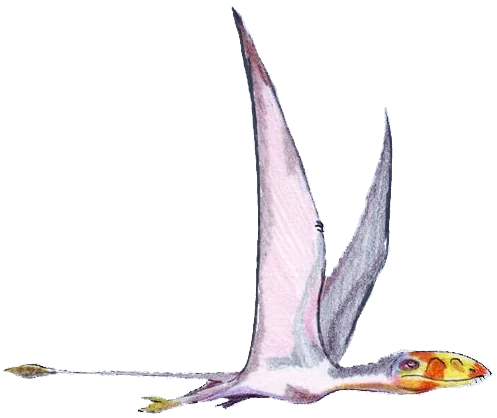
Dimorphodon war ein Flugsaurier mit grossem, hohem Kopf aus dem frühen Jura Englands. Sein Name bedeutet «zweiförmiger Zahn», denn er hatte vorne lange und hinten kleine Zähne. Er war wohl kein guter Langstreckenflieger, konnte aber gut klettern. Die ersten Knochen fand die berühmte Fossiliensammlerin Mary Anning.Dimorphodon was a pterosaur with a large, deep head from the Early Jurassic of England. Its name means "two-form tooth", because it had long teeth at the front and small ones at the back. It was probably not a good long-distance flyer, but it could climb well. The first bones were found by the famous fossil collector Mary Anning.
Mehr InformationenMore information
Im Dezember 1828 fand Mary Anning bei Lyme Regis an der heutigen Jurassic Coast ein Teilskelett ohne Schädel. William Buckland stellte es 1829 vor und beschrieb es 1835 als Pterodactylus macronyx. Nachdem Richard Owen Schädel gefunden hatte, gab er dem Tier 1859 die eigene Gattung Dimorphodon. Das Fundstück von Anning ist heute der Holotyp im Natural History Museum in London.In December 1828 Mary Anning found a partial skeleton without a skull near Lyme Regis on today’s Jurassic Coast. William Buckland presented it in 1829 and described it in 1835 as Pterodactylus macronyx. After Richard Owen had found skulls, he gave the animal its own genus, Dimorphodon, in 1859. Anning’s find is now the holotype at the Natural History Museum in London.
Erwachsene Tiere waren etwa 1 Meter lang und hatten rund 1.45 Meter Spannweite. Die Flügel waren im Verhältnis zum Körper kurz und das Skelett kräftig. Deshalb flog Dimorphodon wohl nur kurze, schnelle Strecken, ähnlich wie heutige Hühnervögel. Mit seinen grossen, gebogenen Krallen konnte er gut klettern.Adults were about 1 metre long and had a wingspan of around 1.45 metres. The wings were short relative to the body and the skeleton was robust. Dimorphodon therefore probably flew only short, fast distances, like modern fowl. With its large, curved claws it could climb well.
Was Dimorphodon frass, war lange umstritten: Insekten, Fische oder kleine Wirbeltiere. Sein Kiefer konnte sehr schnell, aber nicht besonders kräftig zuschnappen. Eine Untersuchung der Abnutzungsspuren auf den Zähnen ergab 2020, dass er vor allem kleine Wirbeltiere frass. Weiche Wirbellose wie Insekten lassen sich aber nicht ganz ausschliessen.What Dimorphodon ate was long debated: insects, fish or small vertebrates. Its jaws could snap shut very quickly, but not very forcefully. A 2020 study of the wear marks on its teeth found that it mainly ate small vertebrates. Soft invertebrates such as insects cannot be ruled out entirely, though.
Wusstest du?Did you know?
- Der Name Dimorphodon bedeutet «zweiförmiger Zahn».The name Dimorphodon means "two-form tooth".5
- Die ersten Knochen fand 1828 Mary Anning, eine der bekanntesten Fossiliensammlerinnen ihrer Zeit.The first bones were found in 1828 by Mary Anning, one of the best-known fossil collectors of her time.5
- Der Schwanz bestand aus etwa 30 Wirbeln, die meisten davon versteift.The tail consisted of about 30 vertebrae, most of them stiffened.5
- Sein Kiefer konnte extrem schnell zuschnappen, aber nur mit wenig Kraft.Its jaws could snap shut extremely fast, but with little force.3
- Richard Owen hielt Dimorphodon für einen Vierbeiner, sein Rivale Harry Seeley für einen möglichen Zweibeiner.Richard Owen thought Dimorphodon walked on four legs, his rival Harry Seeley that it may have walked on two.5
Was man nicht sicher weissWhat we don’t know for sure
- Was Dimorphodon genau frass: vor allem kleine Wirbeltiere, aber Insekten sind nicht ausgeschlossen.What exactly Dimorphodon ate: mainly small vertebrates, but insects are not ruled out.3,4
- Ob am Schwanzende eine Hautfahne wie bei Rhamphorhynchus sass; Abdrücke davon fehlen.Whether there was a skin vane at the end of the tail as in Rhamphorhynchus; no impressions of one exist.5
- Ob die mexikanische Art «D. weintraubi» wirklich zu Dimorphodon gehört; neuere Studien bezweifeln es.Whether the Mexican species "D. weintraubi" really belongs to Dimorphodon; newer studies doubt it.5
VerwandtschaftRelationships
Dimorphodon gehört zu den frühen, langschwänzigen Flugsauriern ausserhalb der Pterodactyloidea. Flugsaurier sind keine Dinosaurier, aber ihre nahen Verwandten innerhalb der Avemetatarsalia.Dimorphodon belongs to the early, long-tailed pterosaurs outside Pterodactyloidea. Pterosaurs are not dinosaurs, but their close relatives within Avemetatarsalia.5
SteckbriefKey facts
- LängeLength
- ca. 1 mapprox. 1 m5
- SpannweiteWingspan
- ca. 1.45 mapprox. 1.45 m5
- ZeitraumTime range
- 201.3–189.6 Mio. Jahre201.3–189.6 million years ago5Frühes Jura (Hettangium bis Sinemurium).Early Jurassic (Hettangian to Sinemurian).
- ErnährungDiet
- FleischfresserCarnivore3,4Wohl vor allem kleine Wirbeltiere, eventuell auch Insekten.Probably mainly small vertebrates, possibly insects too.
- FortbewegungLocomotion
- fliegendflying5Kurze Flüge; am Boden auf allen vieren, guter Kletterer.Short flights; on all fours on the ground, a good climber.
FundorteFossil sites
EntdeckungDiscovery1,2,5
- JahrYear
- 1828
- OrtPlace
- Lyme Regis, Dorset, EnglandLyme Regis, Dorset, England
- Beschrieben vonDescribed by
- Richard Owen (1859, Gattung)
- FundSpecimen
- Holotyp NHMUK PV R1034
Gefunden von Mary Anning; 1835 von William Buckland als Pterodactylus macronyx beschrieben.Found by Mary Anning; described in 1835 by William Buckland as Pterodactylus macronyx.
Wo gefundenWhere it was found
Lage von Lyme RegisLocation of Lyme Regis6 · FundkarteDiscovery map →
GrössenvergleichSize comparison
QuellenSources
- Buckland, W. (1829/1835): On the discovery of a new species of pterodactyle in the Lias at Lyme Regis. Transactions of the Geological Society of London 3
- Owen, R. (1859): On the vertebral characters of the order Pterosauria, as exemplified in the genera Pterodactylus and Dimorphodon. Proceedings of the Royal Society of London
- Ősi, A. (2011): Feeding-related characters in basal pterosaurs: implications for jaw mechanism, dental function and diet. Lethaia 44
- Bestwick, J. et al. (2020): Dietary diversity and evolution of the earliest flying vertebrates revealed by dental microwear texture analysis. Nature Communications 11
- Wikipedia: Dimorphodon (secondary source, accessed October 2026)
- Wikipedia: Lyme Regis (coordinates, accessed October 2026)