CarnotaurusCarnotaurus
Carnotaurus sastrei
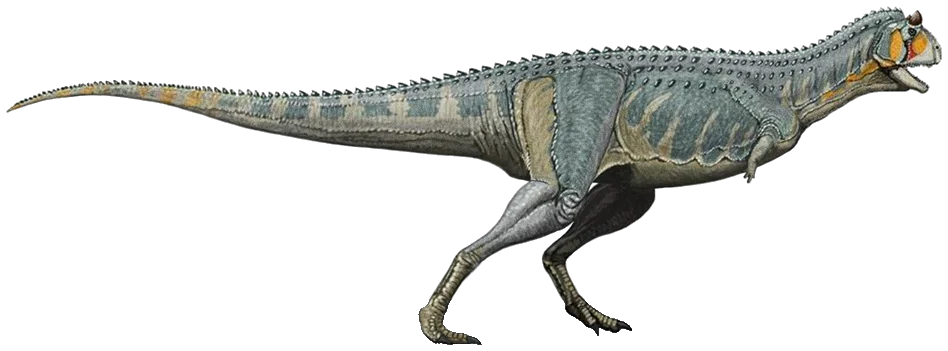
Carnotaurus war ein Raubdinosaurier aus der späten Kreidezeit Argentiniens. Er hatte zwei dicke Hörner über den Augen und winzige Arme, noch kürzer als die von Tyrannosaurus. Mit 7.5 bis 8 Metern Länge war er schlank gebaut und wohl ein schneller Läufer. Von ihm sind grosse Stücke versteinerter Haut erhalten.Carnotaurus was a predatory dinosaur from the Late Cretaceous of Argentina. It had two thick horns above its eyes and tiny arms, even shorter than those of Tyrannosaurus. At 7.5 to 8 metres long it was slender and probably a fast runner. Large patches of its fossilised skin have survived.
Mehr InformationenMore information
Eine Expedition unter José Bonaparte grub das einzige bekannte Skelett 1984 auf der Farm «Pocho Sastre» in der Provinz Chubut aus. Es steckte in sehr hartem Gestein, was die Präparation erschwerte. Bonaparte benannte das Tier 1985: Carnotaurus heisst «fleischfressender Stier», wegen der Hörner; sastrei ehrt den Besitzer der Farm.An expedition led by José Bonaparte dug up the only known skeleton in 1984 on the "Pocho Sastre" farm in Chubut Province. It was embedded in very hard rock, which made preparation difficult. Bonaparte named the animal in 1985: Carnotaurus means "meat-eating bull", because of the horns; sastrei honours the owner of the farm.
Carnotaurus gehört zu den Abelisauriden, grossen Raubtieren der Südkontinente. Der Schädel war hoch und kurz, der Hals muskulös. Die Arme waren kürzer als bei jedem anderen grossen Raubdinosaurier; der Unterarm erreichte nur ein Viertel der Länge des Oberarms. Hautabdrücke zeigen kleine Schuppen und grössere Höcker an den Seiten, aber keine Federn.Carnotaurus belongs to the abelisaurids, large predators of the southern continents. Its skull was tall and short, its neck muscular. Its arms were shorter than in any other large predatory dinosaur; the forearm was only a quarter of the length of the upper arm. Skin impressions show small scales and larger bumps along the sides, but no feathers.
Ein riesiger Schwanzmuskel zog die Beine kräftig nach hinten; Carnotaurus war deshalb vielleicht einer der schnellsten grossen Theropoden. Enge Kurven konnte er aber wohl schlecht laufen. Seine Kiefer bissen schnell, aber nicht besonders kräftig zu; vielleicht jagte er vor allem kleinere Tiere.A huge tail muscle pulled the legs powerfully backwards, so Carnotaurus may have been one of the fastest large theropods. It was probably poor at tight turns, though. Its jaws bit quickly but not particularly hard; perhaps it mainly hunted smaller animals.
Ein CT-Scan des Schädels zeigte 2019 grosse Riechkolben und eher kleine Sehlappen im Gehirn: Carnotaurus roch wohl besser, als er sah, und hörte eher schlecht. Er lebte in einer Küstenlandschaft mit Flussmündungen und Gezeitenflächen, mit trockenen und feuchten Jahreszeiten. Dort gab es auch Lungenfische, Schildkröten, Plesiosaurier, Schlangen und Säugetiere.A CT scan of the skull in 2019 showed large olfactory bulbs and rather small optic lobes in the brain: Carnotaurus probably smelled better than it saw, and its hearing was rather poor. It lived in a coastal landscape with estuaries and tidal flats, with dry and wet seasons. Lungfish, turtles, plesiosaurs, snakes and mammals lived there too.
Wusstest du?Did you know?
- Der Name bedeutet «fleischfressender Stier».The name means "meat-eating bull".3
- Seine Arme waren noch kürzer als die von Tyrannosaurus.Its arms were even shorter than those of Tyrannosaurus.3
- Er war der erste Theropode, bei dem viel versteinerte Haut gefunden wurde.It was the first theropod found with a large amount of fossilised skin.3
- Sein Schwanzmuskel wog pro Bein schätzungsweise 111 bis 137 Kilogramm.Its tail muscle is estimated to have weighed 111 to 137 kilograms per leg.2
- Dieselbe Expedition fand auch den stacheligen Sauropoden Amargasaurus.The same expedition also found the spiny sauropod Amargasaurus.3
Was man nicht sicher weissWhat we don’t know for sure
- Wozu die Hörner dienten: Kämpfe unter Artgenossen, und wenn ja, wie.What the horns were for: fights between rivals, and if so, how.3
- Ob er auch sehr grosse Beute wie Sauropoden jagte.Whether it also hunted very large prey such as sauropods.3
- Wie gut seine Sinne wirklich waren; das Gehirn füllte die Schädelhöhle nur zum Teil, die Schätzungen beruhen auf Annahmen.How good its senses really were; the brain only partly filled the braincase, so the estimates rest on assumptions.5,3
VerwandtschaftRelationships
Carnotaurus gehört zu den Abelisauriden, die in der späten Kreidezeit auf den Südkontinenten die grossen Raubtiere stellten. Mit Tyrannosaurus ist er nur entfernt verwandt.Carnotaurus belongs to the abelisaurids, the large predators of the southern continents in the Late Cretaceous. It is only distantly related to Tyrannosaurus.3
SteckbriefKey facts
- LängeLength
- 7.5–8 m7.5–8 m3
- GewichtWeight
- 1.3–2.1 t1.3–2.1 t3
- ZeitraumTime range
- 69–66 Mio. Jahre69–66 million years ago3Maastrichtium (späte Kreide).Maastrichtian (Late Cretaceous).
- ErnährungDiet
- FleischfresserCarnivore3Wohl vor allem kleinere Beute, vielleicht auch grosse Dinosaurier.Probably mainly smaller prey, perhaps also large dinosaurs.
FundorteFossil sites
- Departamento Telsen, Provinz Chubut, ArgentinienTelsen Department, Chubut Province, Argentina3La-Colonia-Formation
EntdeckungDiscovery1,3
- JahrYear
- 1984
- OrtPlace
- Farm «Pocho Sastre» bei Bajada Moreno, Chubut, Argentinien"Pocho Sastre" farm near Bajada Moreno, Chubut, Argentina
- Beschrieben vonDescribed by
- José Bonaparte (1985)
- FundSpecimen
- Holotyp MACN-CH 894
Wo gefundenWhere it was found
Ungefähre Lage, nur die Region ist angegeben: Telsen DepartmentApproximate location, only the region is given: Telsen Department4 · FundkarteDiscovery map →
GrössenvergleichSize comparison
QuellenSources
- Cerroni, M. A., Canale, J. I. & Novas, F. E. (2021): The skull of Carnotaurus sastrei Bonaparte 1985 revisited: insights from craniofacial bones, palate and lower jaw. Historical Biology 33
- Persons, W. S. & Currie, P. J. (2011): Dinosaur speed demon: the caudal musculature of Carnotaurus sastrei and implications for the evolution of South American abelisaurids. PLoS ONE 6
- Wikipedia: Carnotaurus (secondary source, accessed October 2026)
- Wikipedia: Telsen Department (coordinates, accessed October 2026)
- Cerroni, M. A. & Paulina-Carabajal, A. (2019): Novel information on the endocranial morphology of the abelisaurid theropod Carnotaurus sastrei. Comptes Rendus Palevol 18