VelociraptorVelociraptor
Velociraptor mongoliensis
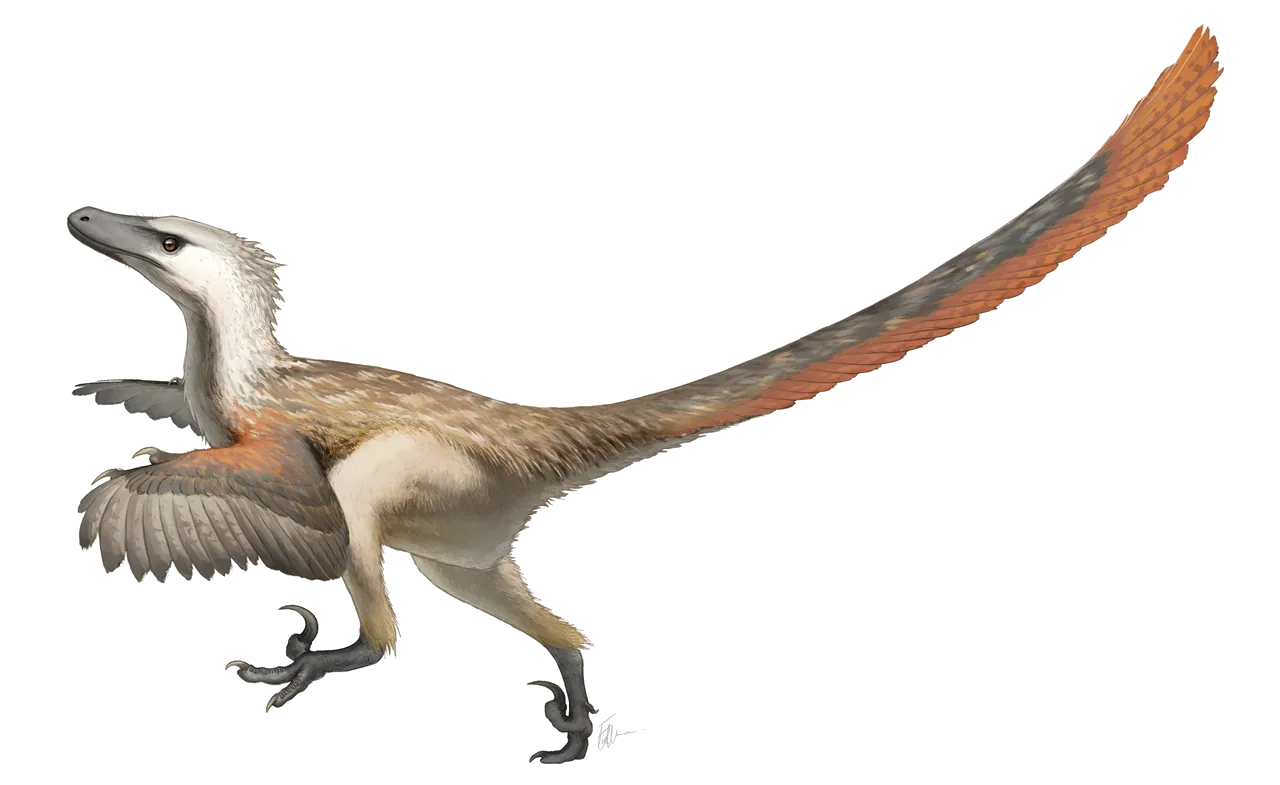
Velociraptor war ein kleiner, gefiederter Raubdinosaurier aus der späten Kreidezeit der Mongolei. Er war etwa so gross wie ein Truthahn mit langem Schwanz, viel kleiner als im Film «Jurassic Park». An jedem Fuss trug er eine grosse, sichelförmige Kralle. Er gehört zu den Dromaeosauriden, nahen Verwandten der Vögel.Velociraptor was a small, feathered predatory dinosaur from the Late Cretaceous of Mongolia. It was about the size of a turkey with a long tail, much smaller than in the film "Jurassic Park". On each foot it had a large, sickle-shaped claw. It belongs to the dromaeosaurids, close relatives of birds.
Mehr InformationenMore information
Am 11. August 1923 fand Peter Kaisen bei einer Expedition des American Museum of Natural History an den Flaming Cliffs in der Wüste Gobi einen zerdrückten, aber vollständigen Schädel. Henry Fairfield Osborn benannte das Tier 1924 Velociraptor mongoliensis, «flinker Räuber aus der Mongolei». Später fanden polnisch-mongolische, chinesisch-kanadische und mongolisch-amerikanische Teams viele weitere Skelette. Alle sicheren Funde der Art stammen aus der Djadochta-Formation.On 11 August 1923, during an American Museum of Natural History expedition to the Flaming Cliffs in the Gobi Desert, Peter Kaisen found a crushed but complete skull. Henry Fairfield Osborn named the animal Velociraptor mongoliensis, "swift robber from Mongolia", in 1924. Later, Polish-Mongolian, Chinese-Canadian and Mongolian-American teams found many more skeletons. All certain finds of the species come from the Djadochta Formation.
Erwachsene Tiere waren etwa 1.5 bis 2 Meter lang, an der Hüfte rund 0.5 Meter hoch und wogen etwa 14 bis 20 Kilogramm; manche Schätzungen gehen bis 2.5 Meter und 28 Kilogramm. An einer Elle fanden Forschende 2007 Ansatzstellen für Federn, sogenannte Federpapillen. Das zeigt, dass Velociraptor Federn an den Armen trug, obwohl er nicht fliegen konnte. Ob dieser Knochen wirklich zu Velociraptor gehört, wird allerdings neu geprüft.Adults were about 1.5 to 2 metres long, about 0.5 metres tall at the hip and weighed about 14 to 20 kilograms; some estimates go up to 2.5 metres and 28 kilograms. In 2007 researchers found attachment points for feathers, called quill knobs, on a forearm bone. This shows that Velociraptor had feathers on its arms even though it could not fly. Whether this bone really belongs to Velociraptor is, however, being re-examined.
Berühmt ist das Fossil der «kämpfenden Dinosaurier» von 1971: Ein Velociraptor hat seine Sichelkralle im Hals eines Protoceratops, der ihm in den Arm beisst. Beide wurden wohl rasch von Sand begraben. Versuche mit einem nachgebauten Bein zeigten, dass die Kralle eher zum Festhalten und Zustechen diente als zum Aufschlitzen. Belege dafür, dass Velociraptor in Rudeln jagte, gibt es nicht.The 1971 "Fighting Dinosaurs" fossil is famous: a Velociraptor has its sickle claw in the throat of a Protoceratops, which is biting its arm. Both were probably buried quickly by sand. Experiments with a model leg showed that the claw was used for gripping and stabbing rather than slicing prey open. There is no evidence that Velociraptor hunted in packs.
Wusstest du?Did you know?
- Der Name bedeutet «flinker Räuber».The name means "swift robber".1,6
- Osborn erwähnte das Tier vor der Beschreibung in einem Zeitungsartikel unter dem Namen «Ovoraptor djadochtari».Before the formal description, Osborn mentioned the animal in a popular article under the name "Ovoraptor djadochtari".6
- Das Fossil der «kämpfenden Dinosaurier» gilt als nationaler Schatz der Mongolei.The "Fighting Dinosaurs" fossil is regarded as a national treasure of Mongolia.6
- Die Form der Augenknochen deutet darauf hin, dass Velociraptor nachts aktiv war.The shape of the eye bones suggests that Velociraptor was active at night.5,6
- Ein Versuch mit einem künstlichen Bein und Schweinebauch zeigte, dass die Sichelkralle zwar einstach, aber nicht aufschlitzte.A test with an artificial leg and pork belly showed that the sickle claw punctured but did not slice open.4,6
Was man nicht sicher weissWhat we don’t know for sure
- Ob der Unterarmknochen mit Federpapillen wirklich zu Velociraptor gehört.Whether the forearm bone with quill knobs really belongs to Velociraptor.2,6
- Ob Velociraptor allein oder in Gruppen jagte; für Rudel gibt es keine direkten Belege.Whether Velociraptor hunted alone or in groups; there is no direct evidence of packs.6
- Wie viele Arten es gibt: V. osmolskae und das Exemplar MPC-D 100/982 könnten eigene Arten sein.How many species there are: V. osmolskae and the specimen MPC-D 100/982 could be separate species.6
- Wie gross und schwer Velociraptor genau wurde.How large and heavy Velociraptor grew exactly.6
VerwandtschaftRelationships
Velociraptor gehört zu den Dromaeosauriden, einer Familie gefiederter Theropoden, die eng mit den Vögeln verwandt ist. Nahe Verwandte sind Deinonychus und Microraptor. Die «Raptoren» in «Jurassic Park» waren eigentlich Deinonychus nachempfunden.Velociraptor belongs to the dromaeosaurids, a family of feathered theropods closely related to birds. Close relatives include Deinonychus and Microraptor. The "raptors" in "Jurassic Park" were actually modelled on Deinonychus.6
SteckbriefKey facts
- LängeLength
- 1.5–2.5 m1.5–2.5 m6Meist 1.5–2.07 m; Paul (2024) schätzt bis ca. 2.5 m.Usually 1.5–2.07 m; Paul (2024) estimates up to about 2.5 m.
- Höhe (Hüfte)Height (hip)
- ca. 0.5 mapprox. 0.5 m6
- GewichtWeight
- 14.1–28 kg14.1–28 kg6Meist 14.1–19.7 kg; Paul (2024) bis 28 kg.Usually 14.1–19.7 kg; Paul (2024) up to 28 kg.
- ZeitraumTime range
- 75–71 Mio. Jahre75–71 million years ago6Campanium (späte Kreide); ein möglicher jüngerer Nachweis aus dem Maastrichtium.Campanian (Late Cretaceous); a possible younger record from the Maastrichtian.
- ErnährungDiet
- FleischfresserCarnivore3,6Jagte unter anderem Protoceratops; frass auch Aas.Hunted Protoceratops among others; also scavenged.
- FortbewegungLocomotion
- zweibeinigtwo-legged6
FundorteFossil sites
EntdeckungDiscovery1,6
- JahrYear
- 1923
- OrtPlace
- Flaming Cliffs (Bayanzag), Wüste Gobi, MongoleiFlaming Cliffs (Bayanzag), Gobi Desert, Mongolia
- Beschrieben vonDescribed by
- Henry Fairfield Osborn (1924)
- FundSpecimen
- Holotyp AMNH 6515
Gefunden am 11. August 1923 von Peter Kaisen.Found on 11 August 1923 by Peter Kaisen.
Wo gefundenWhere it was found
Lage von Flaming CliffsLocation of Flaming Cliffs7 · FundkarteDiscovery map →
GrössenvergleichSize comparison
QuellenSources
- Osborn, H. F. (1924): Three new Theropoda, Protoceratops zone, central Mongolia. American Museum Novitates
- Turner, A. H., Makovicky, P. J. & Norell, M. A. (2007): Feather quill knobs in the dinosaur Velociraptor. Science 317
- Napoli, J. G. et al. (2021): A new dromaeosaurid from Khulsan, central Mongolia. American Museum Novitates 3982
- Manning, P. L. et al. (2006): Dinosaur killer claws or climbing crampons? Biology Letters 2
- Schmitz, L. & Motani, R. (2011): Nocturnality in dinosaurs inferred from scleral ring and orbit morphology. Science 332
- Wikipedia: Velociraptor (secondary source, accessed October 2026)
- Wikipedia: Flaming Cliffs (coordinates, accessed October 2026)