TicinosuchusTicinosuchus
Ticinosuchus ferox
Umstritten: Einordnung oder Deutung werden in der Forschung diskutiert.Contested: its classification or interpretation is debated by researchers.
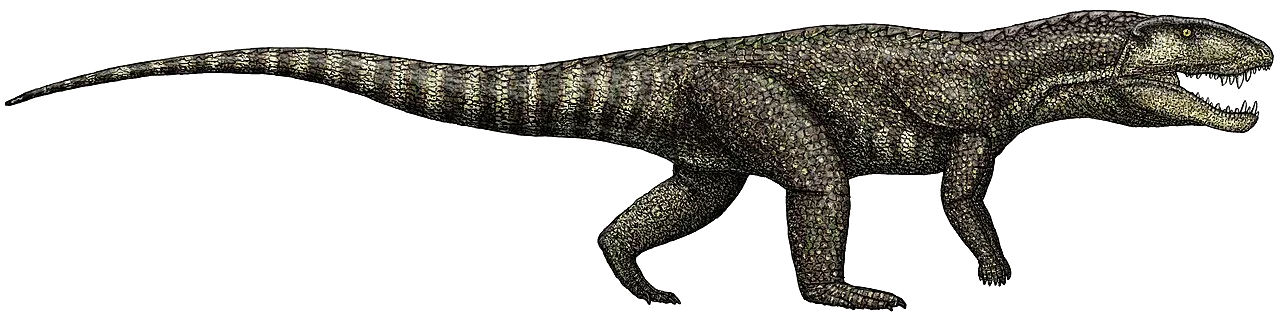
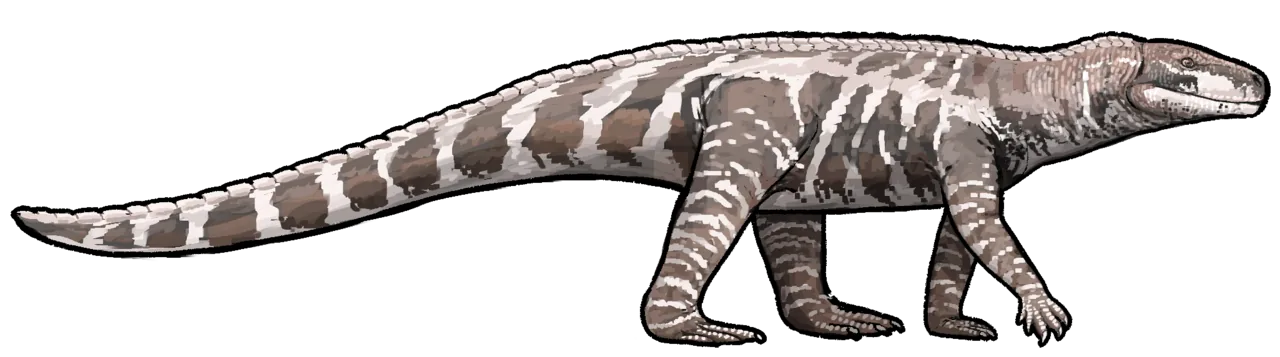
Ticinosuchus war ein etwa 2.5 Meter langer Räuber aus der mittleren Trias, benannt nach dem Kanton Tessin. Sein Skelett stammt vom Monte San Giorgio, einer UNESCO-Welterbestätte an der Grenze zwischen der Schweiz und Italien. Er lief aufrecht auf vier Beinen, und sein Rücken war mit kleinen Knochenplatten bedeckt. Er gehört zur Krokodil-Linie der Archosaurier, ist aber nur entfernt mit heutigen Krokodilen verwandt.Ticinosuchus was a predator about 2.5 metres long from the Middle Triassic, named after the canton of Ticino. Its skeleton comes from Monte San Giorgio, a UNESCO World Heritage Site on the border between Switzerland and Italy. It walked upright on four legs, and its back was covered with small bony plates. It belongs to the crocodile line of archosaurs, but is only distantly related to living crocodiles.
Mehr InformationenMore information
B. Krebs beschrieb Ticinosuchus ferox 1965 anhand eines weitgehend vollständigen Skeletts. Es stammt aus den systematischen Grabungen am Monte San Giorgio, die zwischen 1924 und 1975 stattfanden und deren Funde in Zürich präpariert und erforscht wurden. Der Holotyp befindet sich heute im Naturhistorischen Museum der Universität Zürich. Der Monte San Giorgio gehört seit 2003 zum UNESCO-Welterbe.B. Krebs described Ticinosuchus ferox in 1965 based on a largely complete skeleton. It comes from the systematic excavations at Monte San Giorgio, which took place between 1924 and 1975 and whose finds were prepared and studied in Zurich. The holotype is now in the Natural History Museum of the University of Zurich. Monte San Giorgio has been a UNESCO World Heritage Site since 2003.
Das Skelett wurde in mehreren Stücken geborgen und später wieder zusammengesetzt. Dabei geriet ein Stück der rechten Schädelseite zwischen Teile der linken, weshalb der Schädel länger wirkt, als er war. Ticinosuchus hatte spitze, nach hinten gebogene Zähne und 55 Schwanzwirbel. Vom Hals bis zur Schwanzspitze zogen sich Reihen kleiner, überlappender Knochenplatten.The skeleton was recovered in several pieces and later reassembled. In the process, a piece of the right side of the skull ended up between parts of the left side, which is why the skull looks longer than it was. Ticinosuchus had sharp, recurved teeth and 55 tail vertebrae. Rows of small, overlapping bony plates ran from the neck to the tip of the tail.
Die Besano-Formation, aus der das Tier stammt, ist vor allem für Meerestiere wie Fische und Ichthyosaurier bekannt. Ticinosuchus ist eines der wenigen Landtiere darin. Im Beckenbereich des Skeletts liegen viele Fischschuppen, wohl Reste der letzten Mahlzeit; das könnte erklären, warum ein Landtier an der Küste lebte. Spuren der Fährtengattung Chirotherium ähneln dem, was man von einem Tier wie Ticinosuchus erwarten würde.The Besano Formation, where the animal comes from, is known mainly for marine animals such as fish and ichthyosaurs. Ticinosuchus is one of the few land animals in it. Many fish scales lie near the hips of the skeleton, probably remains of its last meal; this could explain why a land animal lived on the coast. Footprints of the ichnogenus Chirotherium resemble what would be expected from an animal like Ticinosuchus.
Wusstest du?Did you know?
- Der Name bedeutet «Tessiner Krokodil».The name means "Ticino crocodile".6
- Ticinosuchus ist eines der wenigen Landtiere aus der Besano-Formation, die sonst voller Meerestiere ist.Ticinosuchus is one of the few land animals from the Besano Formation, which is otherwise full of marine animals.6
- Im Skelett liegen noch die Fischschuppen seiner letzten Mahlzeit.The skeleton still contains the fish scales of its last meal.6
- Ticinosuchus hatte 55 Schwanzwirbel.Ticinosuchus had 55 tail vertebrae.6
- Der Monte San Giorgio, sein Fundort, gehört seit 2003 zum UNESCO-Welterbe.Monte San Giorgio, where it was found, has been a UNESCO World Heritage Site since 2003.3
Was man nicht sicher weissWhat we don’t know for sure
- Wie Ticinosuchus genau mit anderen frühen Pseudosuchiern verwandt ist.How exactly Ticinosuchus is related to other early pseudosuchians.2,6
- Wie der Schädel wirklich aussah: Er ist zerdrückt und wurde falsch zusammengesetzt.What the skull really looked like: it is crushed and was reassembled incorrectly.6
- Ob Ticinosuchus vor allem Fische frass; der Beleg stammt aus einem einzigen Skelett.Whether Ticinosuchus mainly ate fish; the evidence comes from a single skeleton.6
- Ob Chirotherium-Fährten wirklich von Tieren wie Ticinosuchus stammen.Whether Chirotherium footprints really come from animals like Ticinosuchus.6
VerwandtschaftRelationships
Ticinosuchus gehört zu den Suchia innerhalb der Pseudosuchia und wird zu den frühen Paracrocodylomorpha gezählt, der Gruppe, zu der auch Postosuchus gehört. Seine genaue Stellung wurde 2011 neu untersucht.Ticinosuchus belongs to Suchia within Pseudosuchia and is counted among the early Paracrocodylomorpha, the group that also includes Postosuchus. Its exact position was re-examined in 2011.2,4,6
SteckbriefKey facts
- ZeitraumTime range
- 247.2–237 Mio. Jahre247.2–237 million years ago5,6Anisium bis Ladinium (mittlere Trias); Zahlen nach der internationalen chronostratigraphischen Tabelle.Anisian to Ladinian (Middle Triassic); figures from the International Chronostratigraphic Chart.
- ErnährungDiet
- FleischfresserCarnivore6Fischschuppen im Beckenbereich deuten auf Fische als Nahrung hin.Fish scales near the hips suggest fish as food.
FundorteFossil sites
EntdeckungDiscovery1,3,6
- JahrYear
- unbekanntunknown
- OrtPlace
- Monte San Giorgio, Tessin, SchweizMonte San Giorgio, Ticino, Switzerland
- Beschrieben vonDescribed by
- B. Krebs (1965)
- FundSpecimen
- Holotyp PIMUZ T 4779
Aus den Grabungen der Universität Zürich (1924–1975); das genaue Fundjahr ist nicht dokumentiert.From the University of Zurich excavations (1924–1975); the exact year of discovery is not documented.
Wo gefundenWhere it was found
Lage von Monte San GiorgioLocation of Monte San Giorgio7 · FundkarteDiscovery map →
GrössenvergleichSize comparison
QuellenSources
- Krebs, B. (1965): Ticinosuchus ferox nov. gen. nov. sp. Ein neuer Pseudosuchier aus der Trias des Monte San Giorgio. 81: 1–140 (Zeitschrift je nach Quelle Schweizerische Paläontologische Abhandlungen oder Neues Jahrbuch für Geologie und Paläontologie, Abhandlungen)
- Lautenschlager, S. & Desojo, J. B. (2011): Reassessment of the Middle Triassic rauisuchian archosaurs Ticinosuchus ferox and Stagonosuchus nyassicus. Paläontologische Zeitschrift 85
- Naturhistorisches Museum der Universität Zürich: Monte San Giorgio
- Nesbitt, S. J. (2011): The early evolution of archosaurs: relationships and the origin of major clades. Bulletin of the American Museum of Natural History 352
- International Commission on Stratigraphy: International Chronostratigraphic Chart
- Wikipedia: Ticinosuchus (secondary source, accessed October 2026)
- Wikipedia: Monte San Giorgio (coordinates, accessed October 2026)