PostosuchusPostosuchus
Postosuchus kirkpatricki
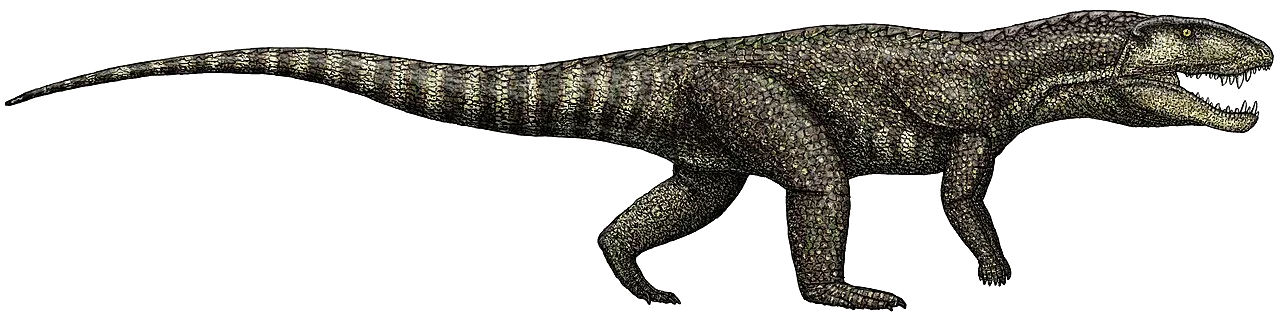
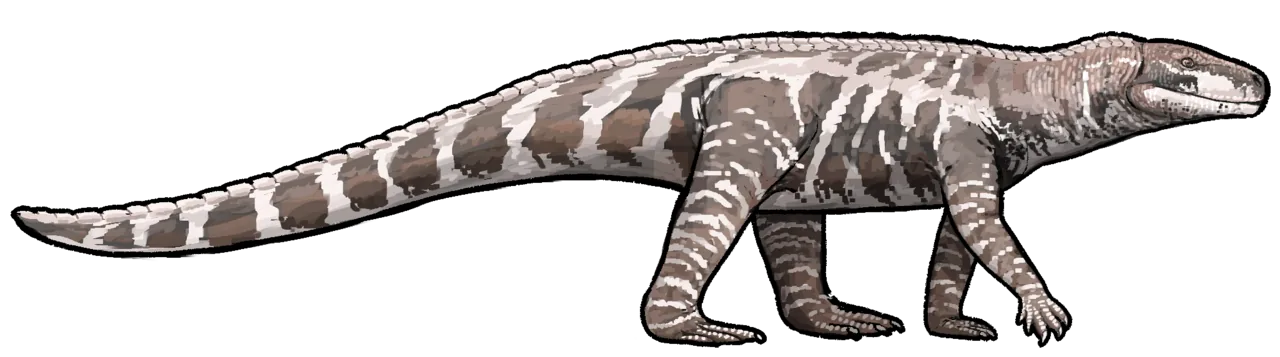
Postosuchus war ein grosser Räuber aus der späten Trias im heutigen Nordamerika. Er sah auf den ersten Blick wie ein Raubdinosaurier aus, gehört aber zur Krokodil-Linie der Archosaurier. Er hatte einen mächtigen Schädel mit dolchartigen Zähnen und lief wohl meist auf den Hinterbeinen. Zu seiner Zeit war er einer der grössten Jäger an Land.Postosuchus was a large predator from the Late Triassic of present-day North America. At first glance it looked like a predatory dinosaur, but it belongs to the crocodile line of archosaurs. It had a massive skull with dagger-like teeth and probably walked mostly on its hind legs. In its time it was one of the largest hunters on land.
Mehr InformationenMore information
1980 entdeckten Forschende der Texas Tech University bei der Stadt Post in Texas eine fossilreiche Fundstelle. Sankar Chatterjee beschrieb daraus 1985 Postosuchus kirkpatricki. Spätere Untersuchungen zeigten, dass das ursprüngliche Material auch Knochen anderer Tiere enthielt, etwa des Poposauriers Shuvosaurus. 2008 kam eine zweite Art aus North Carolina hinzu, P. alisonae.In 1980, researchers from Texas Tech University discovered a fossil-rich site near the town of Post, Texas. From it, Sankar Chatterjee described Postosuchus kirkpatricki in 1985. Later studies showed that the original material also contained bones of other animals, such as the poposaur Shuvosaurus. In 2008 a second species from North Carolina was added, P. alisonae.
Das Skelett des Holotyps war etwa 5 bis 6 Meter lang, ein kleineres Exemplar etwa 3.5 bis 4 Meter. Der Schädel des Holotyps misst 55 Zentimeter und trägt grosse, gezähnte Zähne. Die Vorderbeine sind viel kürzer als die Hinterbeine, ähnlich wie bei Raubdinosauriern. Das Fussgelenk entspricht aber dem der Krokodile, was seine Zugehörigkeit zu den Pseudosuchia zeigt.The holotype skeleton was about 5 to 6 metres long, a smaller specimen about 3.5 to 4 metres. The holotype skull measures 55 centimetres and carries large, serrated teeth. The forelimbs are much shorter than the hind limbs, as in predatory dinosaurs. The ankle, however, matches that of crocodiles, which shows that it belongs to Pseudosuchia.
Ob Postosuchus nur auf zwei Beinen ging, ist umstritten: Eine Studie von 2013 hielt ihn für einen reinen Zweibeiner, andere Arbeiten fanden Hinweise, dass die Hände Gewicht tragen konnten. Beim Skelett von P. alisonae blieb Mageninhalt erhalten, darunter Knochen von mindestens vier anderen Tieren. Postosuchus jagte wohl Pflanzenfresser wie Dicynodonten und Aetosaurier.Whether Postosuchus walked only on two legs is debated: a 2013 study considered it a strict biped, other work found evidence that the hands could bear weight. The skeleton of P. alisonae preserved stomach contents, including bones of at least four other animals. Postosuchus probably hunted plant-eaters such as dicynodonts and aetosaurs.
Wusstest du?Did you know?
- Der Name bedeutet «Krokodil aus Post», nach der Stadt in Texas, in deren Nähe die Funde gemacht wurden.The name means "crocodile from Post", after the town in Texas near which the finds were made.1,6
- Chatterjee sah in Postosuchus 1985 sogar einen möglichen Vorfahren der Tyrannosaurier; heute gilt er als Verwandter der Krokodile.In 1985 Chatterjee even saw Postosuchus as a possible ancestor of the tyrannosaurs; today it is regarded as a relative of crocodiles.1,6
- Im Bauch von P. alisonae fanden sich Knochen von mindestens vier anderen Tieren.The belly of P. alisonae contained bones of at least four other animals.6
- Das Skelett von P. alisonae lag auf einem anderen Tier, dem Krokodilverwandten Dromicosuchus, dessen Schädel Bissspuren trägt.The skeleton of P. alisonae lay on top of another animal, the crocodile relative Dromicosuchus, whose skull bears tooth marks.6
- Die Art P. kirkpatricki ist nach Jack Kirkpatrick und seiner Frau benannt, die bei der Feldarbeit halfen.The species P. kirkpatricki is named after Jack Kirkpatrick and his wife, who helped with the fieldwork.6
Was man nicht sicher weissWhat we don’t know for sure
- Ob Postosuchus ein reiner Zweibeiner war oder sich auch auf die Vorderbeine stützte.Whether Postosuchus was a strict biped or also supported itself on its forelimbs.3,4,6
- Welche Knochen wirklich zu Postosuchus gehören: Das Typusmaterial war mit Resten anderer Tiere vermischt.Which bones really belong to Postosuchus: the type material was mixed with remains of other animals.3,6
- Ob weitere Funde, etwa das Skelett CM 73372, zu Postosuchus gehören; eine Analyse von 2011 verneint das.Whether other finds, such as the skeleton CM 73372, belong to Postosuchus; a 2011 analysis says no.6
- Wie schwer Postosuchus war: Dazu fanden sich keine belastbaren Schätzungen.How heavy Postosuchus was: no reliable estimates were found.6
VerwandtschaftRelationships
Postosuchus gehört zu den Rauisuchiden innerhalb der Loricata und damit zu den Pseudosuchia, der Krokodil-Linie. Er ist näher mit heutigen Krokodilen verwandt als mit Dinosauriern; seine dinosaurierähnliche Gestalt entstand unabhängig.Postosuchus belongs to the rauisuchids within Loricata and thus to Pseudosuchia, the crocodile line. It is more closely related to living crocodiles than to dinosaurs; its dinosaur-like shape evolved independently.1,6
SteckbriefKey facts
- LängeLength
- 3.5–6 m3.5–6 m3Kleineres Exemplar 3.5–4 m, Holotyp 5–6 m.Smaller specimen 3.5–4 m, holotype 5–6 m.
- ZeitraumTime range
- 227–208.5 Mio. Jahre227–208.5 million years ago3,5Norium (späte Trias); Zahlen nach der internationalen chronostratigraphischen Tabelle.Norian (Late Triassic); figures from the International Chronostratigraphic Chart.
FundorteFossil sites
EntdeckungDiscovery1,6
- JahrYear
- 1980
- OrtPlace
- Post Quarry bei Post, Garza County, Texas, USAPost Quarry near Post, Garza County, Texas, USA
- Beschrieben vonDescribed by
- Sankar Chatterjee (1985)
- FundSpecimen
- Holotyp TTUP 9000
Gefunden von einem Team der Texas Tech University.Found by a Texas Tech University team.
Wo gefundenWhere it was found
Ungefähre Lage, nur die Region ist angegeben: Garza County, TexasApproximate location, only the region is given: Garza County, Texas7 · FundkarteDiscovery map →
GrössenvergleichSize comparison
QuellenSources
- Chatterjee, S. (1985): Postosuchus, a new thecodontian reptile from the Triassic of Texas and the origin of tyrannosaurs. Philosophical Transactions of the Royal Society B 309
- Peyer, K. et al. (2008): A new suchian archosaur from the Upper Triassic of North Carolina. Journal of Vertebrate Paleontology 28
- Weinbaum, J. C. (2013): Postcranial skeleton of Postosuchus kirkpatricki from the Upper Triassic of the United States. Geological Society, London, Special Publications 379
- Hutson, J. D. & Hutson, K. N. (2015): Inferring the prevalence and function of finger hyperextension in Archosauria from finger-joint range of motion in the American alligator. Journal of Zoology 296
- International Commission on Stratigraphy: International Chronostratigraphic Chart
- Wikipedia: Postosuchus (secondary source, accessed October 2026)
- Wikipedia: Garza County, Texas (coordinates, accessed October 2026)