SmilosuchusSmilosuchus
Smilosuchus gregorii
Umstritten: Einordnung oder Deutung werden in der Forschung diskutiert.Contested: its classification or interpretation is debated by researchers.
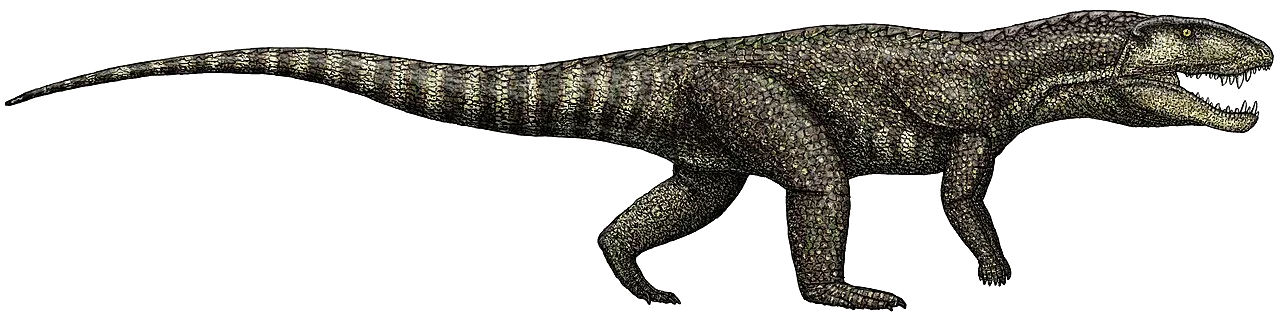
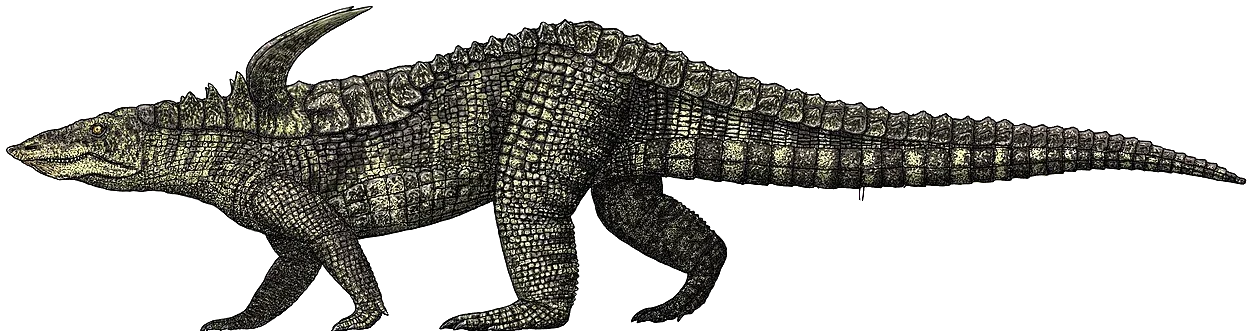
Smilosuchus war ein Phytosaurier aus der späten Trias Nordamerikas. Er sah aus wie ein grosses Krokodil, war aber keines: Die Ähnlichkeit entstand unabhängig. Mit etwa 7 Metern Länge gehörte er zu den grössten Phytosauriern. Seine Nasenlöcher lagen nicht vorne an der Schnauze, sondern weit hinten, fast bei den Augen.Smilosuchus was a phytosaur from the Late Triassic of North America. It looked like a large crocodile but was not one: the resemblance evolved independently. At about 7 metres long it was one of the largest phytosaurs. Its nostrils were not at the front of the snout but far back, almost at the eyes.
Mehr InformationenMore information
Charles Camp beschrieb die erste Art 1930 als Machaeroprosopus gregorii; später wurde sie mehreren Gattungen zugeordnet. Seit 1995 heisst die Gattung Smilosuchus, «Meissel-Krokodil». Alle drei Arten stammen aus der Chinle-Formation in Arizona, aus dem Norium.Charles Camp described the first species in 1930 as Machaeroprosopus gregorii; it was later placed in several genera. Since 1995 the genus has been called Smilosuchus, "chisel crocodile". All three species come from the Chinle Formation of Arizona, from the Norian.
Der Schädel wurde bis 155 Zentimeter lang. Vorne an der Schnauze sassen grosse Fangzähne zum Packen der Beute, weiter hinten klingenartige Zähne zum Schneiden. Ein hoher Knochenkamm auf der Schnauze trug die Nasenlöcher. Die kräftigen Kiefer und die Grösse deuten darauf hin, dass er auch grosse Tiere wie den Pflanzenfresser Placerias jagte.The skull reached up to 155 centimetres in length. At the front of the snout were large fangs for seizing prey, further back blade-like teeth for cutting. A tall bony crest on the snout carried the nostrils. The powerful jaws and its size suggest that it also hunted large animals such as the plant-eater Placerias.
Phytosaurier lebten fast weltweit in der Trias und glichen Krokodilen in Grösse, Aussehen und Lebensweise. Im Unterschied zu Krokodilen fehlte ihnen der knöcherne Gaumen, und ihr Sprunggelenk war einfacher gebaut. Ob sie zur Krokodil-Linie gehören oder sich schon vor der Trennung von Krokodil- und Vogel-Linie abspalteten, ist umstritten.Phytosaurs lived almost worldwide in the Triassic and resembled crocodiles in size, appearance and lifestyle. Unlike crocodiles they lacked a bony palate, and their ankle was simpler. Whether they belong to the crocodile line or split off before the crocodile and bird lines separated is disputed.
Anders als die meisten Krokodile hatten Phytosaurier fein gesägte Zähne. Die Abnutzungsspuren an den Zähnen von Smilosuchus passen zu einem Fleisch- und Fischfresser. Fussspuren zeigen, dass Phytosaurier an Land aufrecht gehen konnten. Eier von Phytosauriern hat man bisher nicht gefunden; eine neuere Studie hält Brutpflege für möglich.Unlike most crocodiles, phytosaurs had finely serrated teeth. The wear on the teeth of Smilosuchus fits a meat- and fish-eater. Footprints show that phytosaurs could walk upright on land. No phytosaur eggs have been found so far; a recent study considers parental care possible.
Wusstest du?Did you know?
- «Phytosaurier» heisst «Pflanzenechse»: Die ersten Funde hielt man fälschlich für Reste eines Pflanzenfressers."Phytosaur" means "plant lizard": the first finds were wrongly thought to be from a plant-eater.3
- Der Schädel von Smilosuchus wurde bis 1.55 Meter lang.The skull of Smilosuchus reached up to 1.55 metres in length.2
- Seine Nasenlöcher lagen fast bei den Augen; so konnte er wohl atmen, während der Körper unter Wasser war.Its nostrils were almost at the eyes, so it could probably breathe while its body was under water.3
- Phytosaurier waren sogar stärker gepanzert als Krokodile.Phytosaurs were even more heavily armoured than crocodiles.3
- Er ist ein Beispiel für konvergente Evolution: Ähnliche Körperformen entstanden unabhängig bei verschiedenen Tiergruppen.It is an example of convergent evolution: similar body shapes arose independently in different groups of animals.3
Was man nicht sicher weissWhat we don’t know for sure
- Ob Phytosaurier zur Krokodil-Linie gehören oder ausserhalb der Archosaurier stehen.Whether phytosaurs belong to the crocodile line or sit outside the archosaurs.3
- Ob Smilosuchus eine eigene Gattung ist oder zu Leptosuchus gehört.Whether Smilosuchus is a separate genus or belongs to Leptosuchus.1,2
- Ob Phytosaurier ihre Jungen betreuten; Eier sind bisher nicht bekannt.Whether phytosaurs cared for their young; no eggs are known so far.3
VerwandtschaftRelationships
Smilosuchus gehört zu den Phytosauriern, die lange als früheste Gruppe der Krokodil-Linie galten. Mit den echten Krokodilen sind sie nur entfernt verwandt.Smilosuchus belongs to the phytosaurs, long considered the earliest group of the crocodile line. They are only distantly related to true crocodiles.3
SteckbriefKey facts
- LängeLength
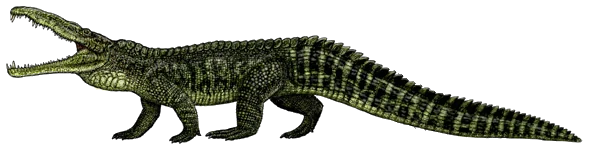
- ca. 7 mapprox. 7 m2Schätzung; der Schädel allein war bis 1.55 m lang.Estimate; the skull alone was up to 1.55 m long.
- ZeitraumTime range
- 221.5–205.6 Mio. Jahre221.5–205.6 million years ago2Norium (späte Trias).Norian (Late Triassic).
- ErnährungDiet
- FleischfresserCarnivore2,3Wohl auch grosse Beutetiere; Zahnspuren passen zu Fleisch- und Fischfressern.Probably also large prey; tooth wear fits meat- and fish-eaters.
- FortbewegungLocomotion
- an Land und im Wasseron land and in water3
FundorteFossil sites
- Arizona, USAArizona, USA2Chinle-Formation
EntdeckungDiscovery2
- JahrYear
- unbekanntunknown
- OrtPlace
- Arizona, USAArizona, USA
- Beschrieben vonDescribed by
- Charles L. Camp (1930, Gattung 1995)
Wo gefundenWhere it was found
Ungefähre Lage, nur die Region ist angegeben: ArizonaApproximate location, only the region is given: Arizona4 · FundkarteDiscovery map →
GrössenvergleichSize comparison
QuellenSources
- Stocker, M. R. (2010): A new taxon of phytosaur (Archosauria: Pseudosuchia) from the Late Triassic (Norian) Sonsela Member (Chinle Formation) in Arizona, and a critical reevaluation of Leptosuchus Case, 1922. Palaeontology 53
- Wikipedia: Smilosuchus (secondary source, accessed October 2026)
- Wikipedia: Phytosauria (secondary source, accessed October 2026)
- Wikipedia: Arizona (coordinates, accessed October 2026)