HelmkasuarSouthern cassowary
Casuarius casuarius
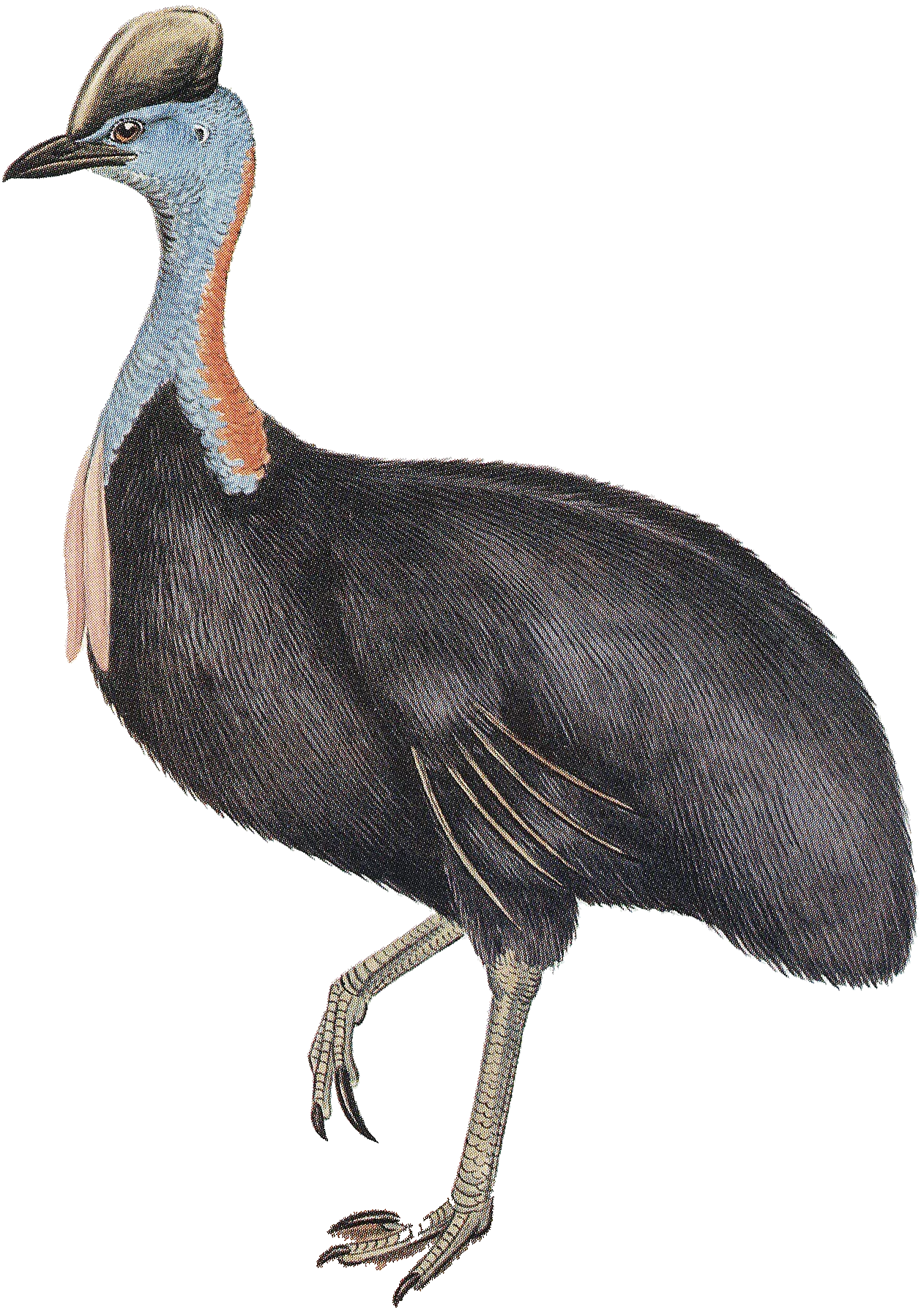
Der Helmkasuar ist ein grosser, flugunfähiger Vogel aus den Regenwäldern Neuguineas und Nordostaustraliens. Er hat schwarzes Gefieder, einen blauen Kopf mit roten Hautlappen und einen hornigen Helm auf dem Kopf. An jedem Fuss trägt er eine bis 12 Zentimeter lange, dolchartige Kralle. Nach dem Strauss gehört er zu den schwersten Vögeln der Welt.The southern cassowary is a large, flightless bird from the rainforests of New Guinea and northeastern Australia. It has black plumage, a blue head with red wattles and a horny casque on its head. Each foot carries a dagger-like claw up to 12 centimetres long. After the ostrich it is one of the heaviest birds in the world.
Mehr InformationenMore information
Carl von Linné beschrieb den Helmkasuar 1758 in seinem Werk Systema Naturae als Struthio casuarius, nach einem Tier von der Insel Seram. Der Name kommt vom malaiischen «kesuari». Kasuare sind die nächsten Verwandten der Emus; zusammen mit Strauss, Nandu und Kiwi gehören sie zu den Laufvögeln.Carl Linnaeus described the southern cassowary in 1758 in his work Systema Naturae as Struthio casuarius, from an animal from the island of Seram. The name comes from the Malay "kesuari". Cassowaries are the closest relatives of emus; together with the ostrich, rhea and kiwi they belong to the ratites.
Meist ist er 1.5 bis 1.8 Meter hoch, die grössten bekannten Tiere etwa 2 Meter. Weibchen sind grösser und schwerer als Männchen: Weibchen wiegen etwa 47 bis 76 Kilogramm, Männchen 29 bis 55. Er rennt bis 50 km/h schnell, springt fast 2 Meter hoch und schwimmt gut. Er frisst vor allem heruntergefallene Früchte und verbreitet so die Samen vieler Regenwaldpflanzen.It usually stands 1.5 to 1.8 metres tall, the largest known birds about 2 metres. Females are larger and heavier than males: females weigh about 47 to 76 kilograms, males 29 to 55. It runs at up to 50 km/h, jumps almost 2 metres high and swims well. It mainly eats fallen fruit and so spreads the seeds of many rainforest plants.
Das Männchen baut das Nest am Boden, brütet die 3 bis 5 grünen Eier etwa 50 Tage lang aus und zieht die Küken allein auf. Kasuare gelten als gefährlich, tödliche Angriffe sind aber sehr selten. Eine Studie zu Angriffen in Queensland zeigte, dass die meisten Angriffe von Tieren ausgingen, die von Menschen gefüttert worden waren. In Australien gilt er als stark gefährdet.The male builds the nest on the ground, incubates the 3 to 5 green eggs for about 50 days and raises the chicks alone. Cassowaries are considered dangerous, but fatal attacks are very rare. A study of attacks in Queensland showed that most attacks came from birds that had been fed by people. In Australia it is listed as endangered.
Wusstest du?Did you know?
- Die Kralle am inneren Zeh wird bis 12 Zentimeter lang.The claw on its inner toe grows up to 12 centimetres long.5
- Beim Kasuar brütet allein das Männchen und zieht die Küken auf.In cassowaries the male alone incubates the eggs and raises the chicks.2,5
- Seine Eier sind leuchtend erbsengrün.Its eggs are bright pea-green.5
- Der Helm leuchtet unter UV-Licht, und zwar in einem anderen Muster als beim Nördlichen Kasuar.Its casque glows under UV light, in a different pattern from that of the northern cassowary.4
- Drei Viertel der untersuchten Angriffe auf Menschen in Queensland gingen von Kasuaren aus, die zuvor gefüttert worden waren.Three quarters of the studied attacks on people in Queensland came from cassowaries that had previously been fed.3
Was man nicht sicher weissWhat we don’t know for sure
- Ob die alten Berichte aus Queensland (1870–1894) über Tiere von 76 bis 119 Kilogramm zuverlässig sind.Whether the old reports from Queensland (1870–1894) of birds weighing 76 to 119 kilograms are reliable.5
- Ob es Unterarten gibt; die Merkmale schwanken stark zwischen einzelnen Tieren.Whether there are subspecies; the features vary greatly between individuals.5
VerwandtschaftRelationships
Der Helmkasuar gehört zu den Urkiefervögeln (Palaeognathae). Seine nächsten Verwandten sind die Emus. Als Vogel ist er ein heute lebender Theropode, also ein Dinosaurier.The southern cassowary belongs to the palaeognaths. Its closest relatives are the emus. As a bird it is a living theropod, and therefore a dinosaur.5
SteckbriefKey facts
- Höhe (stehend)Height (standing)
- 1.5–1.8 m1.5–1.8 m5Typische Höhe; die grössten Tiere etwa 2 m.Typical height; the largest birds about 2 m.
- GewichtWeight
- 29–76 kg29–76 kg5Männchen 29–55 kg, Weibchen 47–76 kg.Males 29–55 kg, females 47–76 kg.
- ZeitalterPeriod
- HeuteToday
- ErnährungDiet
- AllesfresserOmnivore2,5Vor allem Früchte, dazu Pilze, Wirbellose und kleine Wirbeltiere.Mainly fruit, plus fungi, invertebrates and small vertebrates.
- FortbewegungLocomotion
- zweibeinigtwo-legged5Flugunfähig; rennt bis 50 km/h.Flightless; runs at up to 50 km/h.
FundorteFossil sites
EntdeckungDiscovery5
- JahrYear
- 1758
- OrtPlace
- Seram, Indonesien (Typusfundort)Seram, Indonesia (type locality)
- Beschrieben vonDescribed by
- Carl von Linné (1758)
GrössenvergleichSize comparison
QuellenSources
- BirdLife International (2018): Casuarius casuarius. The IUCN Red List of Threatened Species
- Healy, M. (2022): Southern Cassowary (Casuarius casuarius). Birds of the World
- Kofron, C. P. (1999): Attacks to humans and domestic animals by the southern cassowary in Queensland, Australia. Journal of Zoology 249
- Green, T. et al. (2026): Ultraviolet light illuminates species-specific biofluorescent casque patterns in cassowaries (Casuarius). Scientific Reports 16
- Wikipedia: Southern cassowary (secondary source, accessed October 2026)